 The Market Monitor Minding the Nation's Business
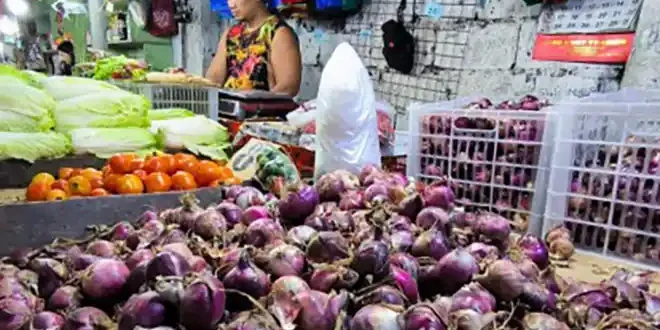
DESPITE its past failure to implement effectively the suggested retail prices for pork and beef, the Department of Agriculture is eyeing adopting SRP for three basic items in Filipino foods– carrots, pork and onions, whose prices have stayed above P200 per kilo since three months ago.
And with the Yuletide season just around the bend, it is more difficult to control the spike in the prices of these items.
Agriculture Secretary Francisco Tiu Laurel Jr. said the SRP would be imposed at the end of November or by December 1 at the latest to ensure that consumers would not be deprived of these pricey commodities.
Initially, the SRP would be applied on pork and carrots. But local and imported onion varieties would soon be given an SRP as most imported onions are being passed on by traders as local produce to jack up their prices.
“Most of these products that I’ve mentioned are imported. Importing is not a right but a privilege,” Laurel said in a briefing on Monday.
“We allow importation because we don’t have sufficient local supply, but there’s a responsibility for them to sell these in the market at a fair price to protect Filipino consumers,” he added.
The maximum SRP for imported pork belly (liempo) will be P370, while foreign shipments of pork shoulder (kasim) and pork ham (pigue) will be P340 per kilo.
Both local and imported (red and yellow) onions along with carrots should be P120 per kilo.
These prices would be in place until the end of January 2026.
Government monitoring data showed that the retail prices of frozen kasim ranges from P210 to P300 per kilo, while frozen liempo sells for between P290 and P350 per kilo.
Local red onions sold in Metro Manila markets range from P250 to P330 per kilo, while imported red onions stand between P200 and P320 per kilo. Imported white onions range from P90 to P180 per kilo.
Retail prices of carrots range from P120 and P200 per kilo.
“We have to understand that the recent spike in prices of onions and carrots was justifiable because of the two successive typhoons that hit the country. But the prices didn’t decline after the typhoons passed,” Laurel said.
Data from the Bureau of Plant Industry (BPI) showed that 707 metric tons (MT) of red onions had entered the country in September; 6,892 MT in October, and; 1,480 MT as of mid-November.
The DA has allowed several importations for onions this year owing to tight supply.
In February, BPI authorized the importation of 4,000 MT of red and yellow onions as stocks thinned out.
This was followed by another importation in August of 50,000 MT for red onions and 35,000 MT for yellow onions to plug the projected supply shortfall.
Laurel assured stakeholders that the government would halt shipments of the onion varieties a month before the February 2026 harvest.