 The Market Monitor Minding the Nation's Business
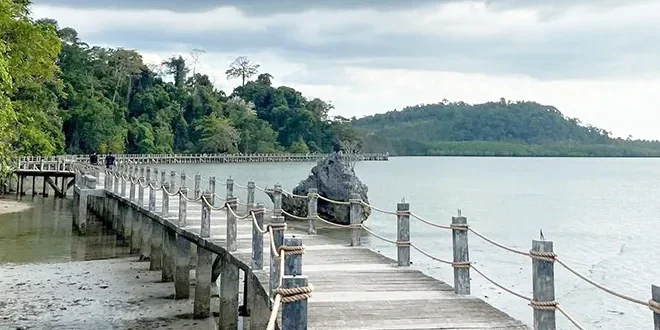
For years, Palawan has consistently ranked among the world’s best destinations.
The province consists of approximately 1,780 islands and islets, stretching from the Calamianes Group in the north to the Balabac Group in the south and the Kalayaan Island Group in the West Philippine Sea.
Its roughly 2,000 kilometers of irregular coastline are lined with rocky coves and white-sand beaches, including the kilometers-long beach of San Vicente and Entalula Beach, which was ranked the world’s best beach for 2026 by USA Today.
Palawan is also home to two Unesco World Heritage Sites: the Puerto Princesa Subterranean River National Park and the Tubbataha Reefs Natural Park.
With many internationally recognized attractions, other Palawan destinations are sometimes overlooked but deserve much attention — and probably inclusion on the Unesco World Heritage List.
This includes the Tabon Cave Complex in the municipality of Quezon, where archaeological discoveries made between 1962 and 1966 by anthropologist Robert Fox and a team from the National Museum of the Philippines, indicated the site was inhabited by early humans for tens of thousands of years.
Quezon is also home to the National Museum’s Tabon Cave Complex, where visitors can connect with the distant past through galleries devoted to natural history, Palawan’s diverse cultures, and the archaeological discoveries made within Lipuun Point.
Beyond its archaeological sites, Quezon has many lesser-known attractions that can rival those found in Palawan’s more established tourism destinations. These include remote islands, waterfalls, and challenging mountain peaks.
The Indigenous Tagbanua and Palaw’an peoples inhabited Quezon and the surrounding areas centuries before Spanish colonization reached Palawan.
These communities lived through hunting, fishing and farming. They also traded with China and other parts of Asia, as evidenced by Chinese ceramics discovered in the area. These finds indicate that Quezon formed part of ancient maritime trading routes.
Settlers from Borneo and the Malay Peninsula later arrived, bringing new agricultural practices and Islamic influences.
Spanish colonizers reached the area during the 17th century and constructed churches and forts in Palawan to protect communities against pirate attacks. But Quezon remained relatively isolated from direct colonial influence.
The municipality of Quezon was established in 1951 from several barrios previously belonging to the municipalities of Aborlan and Brooke’s Point. Originally named Tabon, the municipality was later renamed in honor of Manuel Luis Quezon, the second president of the Philippines.
Today, Quezon covers approximately 943 square kilometers and has a population of about 70,000.
The Tabon Caves are part of an important archaeological cave system at Lipuun Point in Quezon. Because of the number and significance of the artifacts discovered there, the complex is often described as the Philippines’ “cradle of civilization.”
Anthropologist Robert B. Fox led extensive excavations at the site between 1962 and 1966. These revealed layers of evidence showing human activity over different periods.
One of the most important discoveries was the partial skullcap commonly associated with “Tabon Man.” The remains have been dated to between 22,000 and 24,000 years old, making them among the oldest known human remains discovered in the Philippines.
Archaeologists have also documented around 1,500 burial jars scattered throughout the cave system. These ceramic vessels were used to hold human remains, including cremated bones, and were often accompanied by grave goods.
The most famous artifact associated with the complex is the Manunggul Jar. The decorated burial jar is distinguished by the figures aboard a boat on its lid. It is widely regarded as a symbol of Philippine prehistoric art, spirituality, and maritime culture.
There are 218 known caves within Lipuun Point. Of these, 29 have been systematically explored by archaeologists.
Only seven — including Tabon Cave, where the remains associated with Tabon Man were discovered — are currently open to the public. Access is restricted to reduce the impact of tourism on the more fragile and less-studied chambers.