 The Market Monitor Minding the Nation's Business
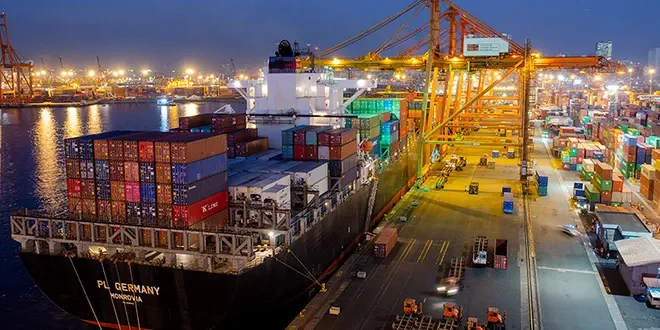
The Philippine economy continues to report discouraging numbers, as both exports and imports posted slower growth in July, with decreased valuation compared to the previous month.
Data released by the Philippine Statistics Authority (PSA) on Aug. 28 showed exports grew by 10.8 percent year-on-year to $8.15 billion in July, sharply slower than the 25-percent expansion in June. Imports likewise rose by 19.8 percent to $14.12 billion, easing from the 25-percent growth recorded a month ago.
In value terms, exports fell by $681.31 million, or 7.7 percent, from the revised monthly record high of $8.83 billion in June, while imports declined by $204.52 million, or 1.4 percent, from $14.33 billion. As a result, total external trade dropped by $885.83 million, or 3.8 percent, month-on-month to $22.27 billion from $23.16 billion.
The July export value was the lowest since May, when outbound shipments amounted to $7.95 billion, while imports were also at their lowest since May’s $14.05 billion.
The slower trade performance came despite continued strong demand for Philippine electronic products, which remained the country’s top export commodity.
Electronics exports reached $4.79 billion in July, accounting for 58.8 percent of total outbound shipments. They also recorded the biggest annual increase among commodity groups, rising by $869.72 million from $3.92 billion a year ago.
Other commodities that contributed to the annual increase in exports were gold, which rose by $79.34 million; electronic equipment and parts, up by $71.81 million; machinery and transport equipment, up by $50.06 million; and woodcrafts and furniture, up by $30.92 million.
By major type of goods, manufactured goods remained the largest source of export earnings at $6.61 billion, equivalent to 81.1 percent of total. Mineral products followed at $776.61 million, or 9.5 percent of total, while agro-based products accounted for $548.95 million, or 6.7 percent.
Despite the July slowdown, exports in the first seven months of the year climbed by 12.9 percent to $54.92 billion from $48.67 billion in the same period last year, the highest January-to-July export value since the series began in 1991.
China, which includes its autonomous region Hong Kong, remained the Philippines’ biggest export market in July, accounting for $2,209,820,000.
This was followed by the United States (US) with $1.68 billion, or 20.7 percent of total exports. It was followed by Hong Kong at $1.29 billion, China at $919.82 million, Japan at $856.6 million, and Singapore at $401.17 million.
On the import side, electronic products also posted the biggest annual increase, surging by $1.75 billion to $4.6 billion and accounting for 32.6 percent of total imports.
This was followed by mineral fuels, lubricants and related materials, which increased by $502.71 million to $1.95 billion, and cereals and cereal preparations, which rose by $187.36 million to $561.06 million.
Raw materials and intermediate goods comprised the biggest share of imports at $5.71 billion, or 40.4 percent, followed by capital goods at $3.84 billion, or 27.2 percent, and consumer goods at $2.58 billion, or 18.3 percent.
From January to July, imports increased by 18.9 percent to $92.26 billion from $77.58 billion a year ago, also the highest first-seven-month import value since the series began in 1991.
China remained the country’s largest source of imported goods, supplying $4.17 billion, or 29.5 percent of total imports in July. It was followed by South Korea with $1.8 billion, Japan with $1.11 billion, Indonesia with $807.75 million, and the US with $766.61 million.
With imports continuing to outpace exports, the country’s balance of trade in goods posted a deficit of $5.97 billion in July, 34.9 percent wider than the $4.43-billion shortfall a year ago and the widest since the $6.1-billion deficit recorded in May.