 The Market Monitor Minding the Nation's Business

The Philippines is making a major push to rediscover its oil and gas potential, reviving large-scale government-funded exploration mapping for the first time in about four decades.
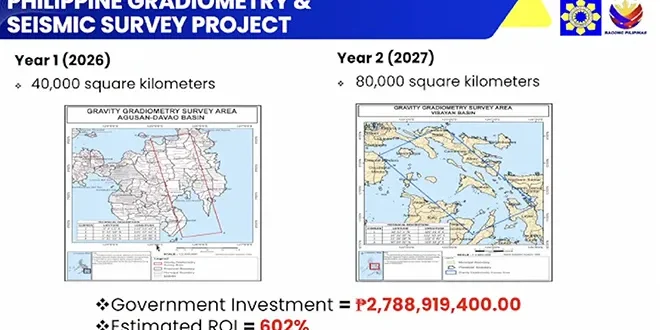
The Department of Energy (DOE) is investing nearly ₱2.8 billion in new geophysical surveys covering about 120,000 square kilometers across the Agusan-Davao and Visayan basins, hoping better data will draw private investors back into areas that once showed promise for natural gas.
DOE Undersecretary Alessandro Sales said the government’s latest initiative marks a significant return to state-funded exploration after the last comparable data-acquisition campaign in the 1980s, which was financed by the World Bank.
“(It’s a) milestone that after so many decades, we are again investing in our own basins,” Sales said during Thursday’s Senate hearing on the DOE’s proposed 2027 budget.
The Philippine Gradiometry and Seismic Survey Project will initially cover 40,000 square kilometers in the Agusan-Davao basin in 2026, followed by an 80,000-square-kilometer survey of the Visayan basin in 2027.
The DOE has programmed ₱2.789 billion for the project and estimates that it could produce a 602-percent return on investment by lowering exploration risks and encouraging companies to pursue petroleum service contracts.
Officials said the total survey area could potentially accommodate up to 120 exploration service contracts. Even if only 10 percent of that potential is developed, the government estimates it could generate around ₱16.8 billion in private-sector investments, excluding possible revenues from commercial oil or gas discoveries.
Sen. Pia Cayetano, who presided over the budget hearing, underscored the importance of providing investors with better information because petroleum exploration requires substantial capital even before companies know whether they will find commercially viable reserves.
“I want people to know that we’re investing in this kind of exploration,” Cayetano said.
Sales said the Agusan-Davao and Visayan basins were chosen based on earlier studies in the 1970s and 1980s that pointed to their gas potential. At the time, however, natural gas had not yet developed into a commercially significant fuel, limiting exploration activity.
The areas eventually became what Sales described as “forgotten” basins as investment and exploration declined.
“But it could really matter to the future of the country if we find more indigenous gas in these what we call forgotten areas,” Sales said.
Under the Philippine Energy Plan 2023-2050, the survey aims to generate updated information on underexplored sedimentary basins, improve assessments of petroleum resources and identify potential new oil and gas fields.
The DOE also sees locally produced natural gas as a potential way to reduce the country’s dependence on imported fuel while complementing renewable energy sources as electricity demand continues to grow.
Updated geological data could help investors make more informed decisions before committing billions of pesos to exploration. DOE officials also pointed to the country’s natural gas policy, which gives preference to indigenous gas, potentially providing successful explorers with a domestic market for commercially viable discoveries.
The survey is one of the major initiatives supporting the DOE’s proposed ₱5.58-billion budget for 2027, as the government seeks to unlock more domestic energy resources.