 The Market Monitor Minding the Nation's Business
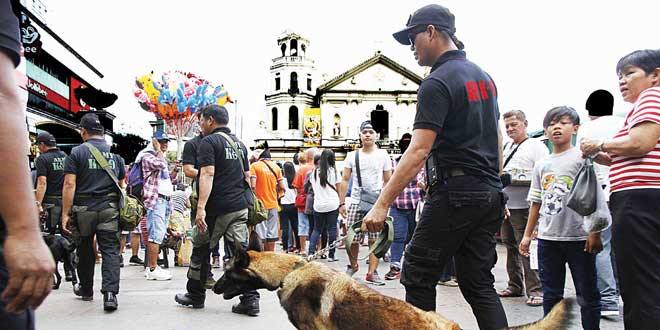
The area around Quiapo was practically placed on a lockdown since Saturday as the government spared no effort to thwart a supposed terrorist threat during the celebration of the annual feast of the Black Nazarene this Monday.
Just like last year, signal jammers were installed along the route of the procession and the vicinities of Quirino Grandstand in Luneta and the Minor Basilica of the Black Nazarene located in Quezon Boulevard, Manila during the celebration of the annual feast.
According to Col. Llewelyn Binasoy of the Armed Forces of the Philippines (AFP), the installation of signal jammers was part of security measures for the annual event where an estimated 2 million devotees to the Black Nazarene traditionally gather to pay homage to the supposedly miraculous religious icon.
“As part of security preparations of Traslacion 2017, all areas near the the route of procession would have no signals so I hope you understand it is part of the security preparations,” he said.
Binasoy said the areas in Manila where the Mass and procession were held were also declared as a no-fly zone for all aircraft including drones.
“We asked from the media and the public not to have their drones in the air. We gave fair warning to everyone as part of the security and the declaration of a “no fly zone” during the Traslacion,” he added.
Binasoy said AFP personnel were also deployed in Luneta, Quiapo and at the route of the procession to provide security and to help maintain peace and order.
On the other hand, Ensign Mozart Cumbe of the Coast Guard (CG) appealed to the public especially those who will be joining the procession to refrain from jumping off the Jones Bridge, part of the Traslacion route going to the Basilica.
Cumbe said CG’s river marshals and National Police (PNP) maritime police were also deployed to monitor activities particularly under the bridge.
But, Cumbe said the incidents of people jumping off the bridge have decreased in recent years.
Aside from the said agencies, other government offices such as the Department of Public Works and Highways, Bureau of Fire Protection, Department of Health, the local government of Manila are closely coordinating with the officials of the Quiapo Church headed by Msgr. Hernando Coronal, rector, to ensure a safe and organized event.
Social media coverage
The organizers of the 2017 Traslacion also tapped the power of social media to be able to reach millions of Filipinos across the globe particularly devotees of the Black Nazarene.
According to Msgr. Hernando Coronel, rector and parish priest of the Minor Basilica of the Black Nazarene, more popularly known as Quiapo Church for the week-long celebration of the feast on Jan. 9, Facebook Live (FB Live) enabled Filipinos who are living or working in countries around the world to witness the celebration online.
Though, the Quiapo priest admitted that they have imperfections they will try to show the procession on FB live.
Coronel noted that the idea of using social media for this year’s celebration was based on what they have experienced when they allowed live streaming of simbang gabi masses last month, where they got millions of comments.
He added that using the social media is not only for Filipinos abroad but also to those who are in the country but will not be able to attend the activities for some reason.
The DOH also placed all government hospitals along the route of the Black Nazarene procession under Code White which meant hospital staff, such as general and orthopedic surgeons, anesthesiologists, internists, operating room nurses, ophthalmologists and otorhinolaryngologists were on call for any emergency situation.
It also means that nursing and administrative personnel residing at the hospital dormitory were placed on alert in anticipation of public health emergencies that may result during large gatherings of people.
Every year, millions of Black Nazarene devotees join the ‘Traslacion’ to seek healing and blessings or fulfill a ‘panata’ or vow after their wishes were granted to them.
During the procession, which starts at the Quirino Grandstand and winds its way back to Quiapo Church, the devotees –- who walk barefoot —jostle one another to touch the image of the Black Nazarene for blessings.
Anticipating injuries in such a huge gathering, the DOH and its partner organizations, such as the Philippine Red Cross, coordinate their efforts to provide medical assistance.
Health department spokesman Eric Tayag, said eight medical teams will be spread out in strategic areas and will be supported by medical teams of the PRC to ensure faster response.
Dr. Tayag noted that last year, the medical teams attended to almost a thousand devotees, half of whom suffered injuries during the procession. Some of them were pushed or squeezed while others stepped on pointed objects.
Last year, he said, two deaths were recorded — one from a heart attack and the other from a liver disease.
He said he understands that faith drives these devotees—especially those who are ill—to join the procession to seek healing. He however advised parents against bringing small children with them and pregnant women and senior citizens who are suffering from severe ailments to skip the procession and just visit the Black Nazarene some other time.
However, if senior citizens or those with disabilities insist on joining the ‘Traslacion’, he advised them to at least bring a companion and their medication.
Tayag also advised devotees to bring water to prevent dehydration and not to postpone the call of nature. They should know beforehand the locations of comfort rooms, he said. PNA