 The Market Monitor Minding the Nation's Business
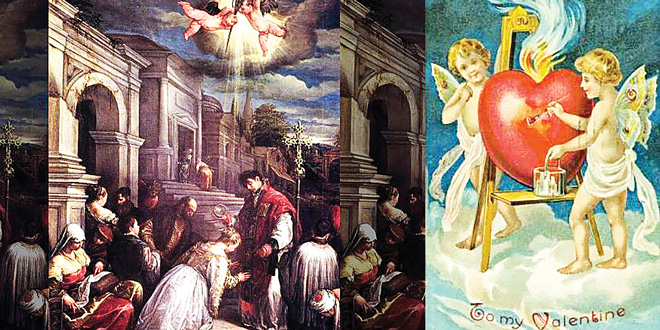
 In our world swirling in disparate states of mind, I thought it unlikely that in the tightening tangle of ideas, events and chatter, among millions jostling in cyberspace—which now characterize our lives—“love” as a theme should be nothing but a flotsam in the tides. Not so, I found out.
Instead, here is how the world heaves a daylong declaration of love unwittingly in honor of him, who, are we even aware of as, “saint”? As of last count from a website: “…approximately one billion Valentine cards exchanged and 110 million roses sold and delivered each year…”
Add to that, the many untallied email, text messages, Twitter declarations, Skype, Viber and FaceTime calls, as well as the unmetered whispers between lovers on Valentine’s Day. I guess all these could count as prayers to him we hardly ever address as saint but after whom we often endearingly refer to a lover as “Valentino.”
Sleuthing for St. Valentine in whose name we honor tomorrow, a day which literally seizes the earth in a tizzy, I got caught in a web of legends, lore, and metaphors, dating as far back as the 3rd century A.D.—a proof that “love” remains not just a mere word but rather that elusive power causing life to stir. Of course, why shouldn’t love be as old as the universe? Isn’t that of Adam and Eve a love story?
Yes, indeed, there lived a St. Valentine, three of them, in fact. But only one legend is fully told, that of a “temple priest jailed for defiance during the reign of the Roman emperor, Claudius, the Goth (Claudius II)” around the middle of A.D. 250, the early centuries of Christianity, according to a Valentine’s Day website.
As unraveled, his crime had to do with a law banning new marriages surely among converts whose weddings he officiated in secret; Rome faced persistent battles then, and newlywed young men refused to leave their scented beds. For me, this alone merited his being a patron saint of lovers. But there’s more.
It is said that Valentinus cured the daughter of his jailer, who often visited him, of her blindness—a miracle, which almost converted the emperor to Christianity. Valentinus did begin to work on Claudius, an act, though, that exacerbated his crime and led to his beheading at the gate of Flaminian Way. On the way to his execution, somehow he had scrawled a note that said, what billions now use in a million ways to tag their Valentine gifts, “from your Valentine” in a cutout heart he gave to converts.
Should I end here with this background, which perhaps isn’t new to some, I would have left out the interlacing of history and lore about Valentine’s Day. Like this one: Did Valentinus’s date of beheading on February 14 just by chance happen during the week of three Ancient Roman festivals? Texts from the website do describe the opening day of the rituals on February 13 as “dedicated to peace, love, and household goods.”
But the next day, the 14th, bears no scant hint the way we celebrate the date today; apparently, it involved sacrifices by vestal virgins to the goddess Juno Lupa, the She-Wolf, who is said to have nursed Remus and Romulus, the twins in the founding of Rome, and peaked to a climax where priests smeared the blood of a sacrificial goat or dog on the foreheads of young men of noble birth clad in nothing but goatskin thongs. Kind of anointed and armed with goatskin strips, they led in a purification and fertility rite by whipping (“februatio” in Latin meaning “to purify”) the fields, and I suppose, the vineyards, but especially, young women, who were gently lashed—each to be made fertile.
It is in the following day, the 15th, identified as the “Ides of February” in ancient Roman calendars–believed to be dedicated to Jonu Februata, the goddess of women and marriage–where I find a link to St. Valentine. In a custom, called Luperci, young women who were willing to be matched dropped their names in an urn from which young men would draw that of their partners for a year.
While some sources identified the mating as “lewd” or meant only to gratify youthful urges, most were known to have ended in marriage. Possibly, about the time of Valentinus was when such marriages were banned, which he defied at the cost of his life; it took 200 years before he was canonized under Pope Gelasius in A.D. 496.
Except for the blind girl, I found no other miracle attributed to St. Valentine. Was there perhaps a doomed match he interceded for reversal or a lost lover returned to a hapless beloved? Or a rock-splintered marriage made whole again with pleas through him?
Knowing how meticulous the church combs through the cause for canonization, I think we should learn more about the miracles of St. Valentine, whom the Church declared as the “patron of lovers and good marriage” 1,517 years ago because I know how dire our world needs him. Yet, I’m not aware if there exists a novena to him.