 The Market Monitor Minding the Nation's Business
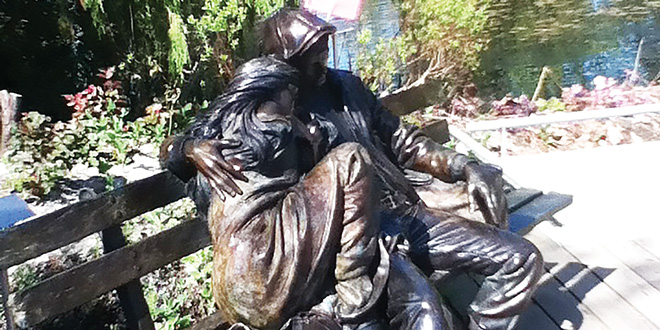
 While aging shows first in the hair and skin, for me, it does on lids when slackened, the sadness of what’s gone and the oncoming night, hint the most at such external inevitability.
Hence, some truth that the culprit is this “much too solid flesh,” as Shakespeare wrote.
But what never manifests itself, until by some unexplained leap from that boundless interior sea, our own selves, is a kind of agelessness propelled by the most abstract of emotions—love both in its beauty and ridiculousness, and joy at its most unbridled, regardless of how it is expressed.
Who is not familiar with caricatures of old age rampant in advertisements, sitcoms, movies, comic strips, and novels? Like what comes to mind: An elderly couple’s unabashed glee in a summer come-on at a southern beach, possibly in Florida, the gleaming shoreline at mid-morning, sand as yet flawless as virgin skin, and a few beachcombers as lazy as the sea mid-range off camera; suddenly from behind a clump of beach grass, an elderly pair in the buff would jump out, zigzagging toward the water.
The camera would then freeze on onlookers, hands on mouth, and some covering their eyes. Quite easy for me to have dismissed it as an exaggerated image but though not really that extreme, I found out, because it’s rather common in summer resorts, and here in Vancouver, during winter events like the Bear Plunge, where the elderly turn out to be the most daring. The young do feel squeamish, if not patronizing, about such “unbecoming” behavior, and fairly so—what with archetypes of elders as couch potatoes, or figures ruled by rigid manners even to a point of lifelessness, add to these, a perception of fragility, which readings on ageing zeroing in on illnesses endorse. But such attitude has not tamped down the elderly from giving in to their nature as human beings—falling in love, in particular.
The latest buzz on Phoebe’s mom (not her real name as per her request), for instance, has no reference to her shopping mania but her having moved in with a husky man, young enough to be a menopausal son. At first, dismissed by her 50-and-up daughters, as a fling, it has taken root literally in the woods off St. Johns, Newfoundland’s capital city, where she had reigned in youthfulness both in attitude and bearing. Apparently, shedding off her diva ways, she now fetches water from a pump off the kitchen, and at times, carries log for the stove and heating; her daughters, though, have not stopped conspiring to “get some sense into her.” As well, “mellow,” a word associated with aging, I think as coined should stay with wine and less as a hoped-for elderly state—also my own thinking. The shell that the body merely is for the million particles that make up who we are may slow down and corrode but passions, those once raging flames it encases remain hot and live that if fanned, do blaze into a conflagration.
Love that rejects betrayal, especially for women, could roar with its vicious face like in an older sister of my father, who, well into her mid-80s found out about a child her husband had in one of the towns where he served as supervisor. In a blink, she transformed from the lovely young nurse he had eloped with to faraway Masbate, abandoning her family, into a stone-hearted Hera, venting rage not on her husband’s Ismene, but her own Zeus up to his death and hers. Their ghosts haunt their house to this day, perhaps seeking forgiveness, as I last heard from my cousins. But I can only highlight these few among so many more real-life stories I know as I write this column, prompted by Hannah Furness’s report at The Telegraph sometime ago on Deborah Moggach, a screenplay writer and novelist. Speaking at The Telegraph Ways With Words festival in Devon, UK, Moggach argued that films and books about older people should reflect reality from age 65, when “the big ‘raft of time’” thereon does not deal with “impending death” but about falling in love, being jealous, feeling “the same joy, same everything—you’re just a bit wrinkly.” Moggach is known, of course, as author of “These Foolish Things” adapted into the movie, “The Best Exotic Marigold Hotel,” which stars among others, Dame Judi Dench, and Dame Maggie Smith.
Old-age ills, indeed, weigh heavily as stark realities that should be addressed. But then again, not considering genetics or mutant factors that suddenly pop up to cause dementia or any condition that defies understanding, I believe social messages that configure older persons as “less-than-human,” and even shorn of it, hence, voiding their inner realities have intensified their perceived condition while supporting a false view of our humanity.
Did perhaps a movement behind Moggach spark a change? If, as a Baby Boomer—the generation she identifies with—I had been lit, I’m certain with more of us, holding up a torch, we might just wake up a dozing world into some truth that somehow, we don’t really age.