 The Market Monitor Minding the Nation's Business
By DIEGO C. CAGAHASTIAN
Unknown to ordinary Filipinos in the country, the ubiquitous SM logo is making waves in China. In fact, the highly diversified conglomerate that started from selling shoes and retail merchandising in Quiapo and founded by Henry Sy Sr. has been dominating Fujian province in China’s south, particularly Jinjiang and Xiamen.
The dominant Filipino brand in malls and mix-use development has solidified its beachhead in China.
SM’s reach also extends to the provinces of Shandong, Jiangsu and Sinchuan as well as the municipalities of Chongqing and Tianjin. Filipino business reporters and editors who recently visited SM Xiamen noted that the SM Prime Holdings group has built shopping malls in nine locations, covering a gross floor area (GFA) of 1.8 million square meters.
The homegrown concept of mall shopping perfected by the SM group in the Philippines where it operates 90 branches called Supermalls, with seven additional malls under construction, has become a great success in China.
The group is also into land banking, buying vast tracts of land in key towns and cities for future development and expansion.
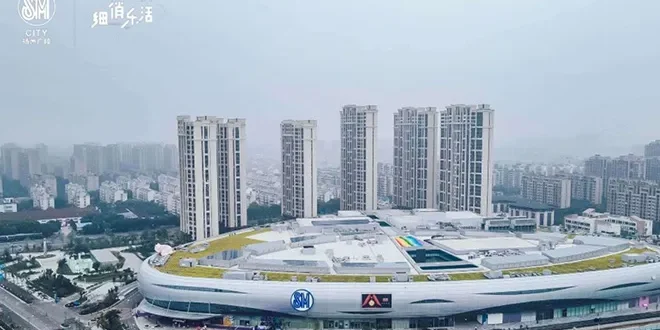
It was reported that SM City Xiamen is now the single biggest shopping complex in all of Fujian. Xiamen has a total population of 5.36 million. The urbanized area covers six districts, extending into neighboring Zhangzhou and Quanzhou to form a wider metropolitan area with over 7.2 million.
This market is served by the 460,000 square meters of GFA built in three phases over the last 25 years. The SM City Xiamen complex has three retail blocks, each with a distinct market positioning to capture a diverse consumer base.
SM City Xiamen was also the very first mall that the Sy family opened in China, back in 2001.
SM Prime Holdings president Jeffrey Lim noted that both the local governments and national authorities in China were very supportive of their business. He cited that when Henry Sy started SM there, “we were given a huge tract of land.”
It was in Jinjiang because Sy remembered his roots, and was a great believer in Deng Xiao Ping’s opening up of China. Jinjiang in southeastern Fujian was the first city in China where Sy chose to invest. It is also in Jinjiang, the hometown of Dr. Jose Rizal’s ancestor Domingo Lamco, where the government erected the Rizal Monument copied from the one in Luneta. Rizal and Sy are among the sons of Jinjiang honored in a museum there which I visited in 2017. During this visit, I also noted that the snack foods in the hotel’s mini bar are made by another Filipino homegrown company, Liwayway Marketing, makers of the popular Oishi prawn crackers, which is one of the pioneer Filipino companies in China. Liwayway Marketing is headed by Carlos Chan.
It is understandable that Teresita Sy-Coson, vice chair of SM Investments Corp. continues to urge the Philippine government to engage China in dialogue instead of calling it out for perceived aggression in the South China Sea.
Sy-Coson has told Bloomberg that “we don’t want to get involved in the US-China tensions. What we have to do is to have peaceful discussions with them because, after all, we can’t change our neighbors.”
Teresita’s plea seems to fall to deaf ears in the Palace and in Camp Aguinaldo, not to mention the DFA.
While the government asks China for help during the current oil crisis, and while the Department of Trade and Industry attracts foreign investors to do business in the Philippines, Gibo Teodoro and his staff, together with the Armed Forces and Bureau of Immigration are driving away Chinese workers, technicians and businessmen from the Philippine Sanjia Steel Corp. in Tagoloan, Misamis Oriental.
China has financial and technological interests in the Philippine Sanjia Steel, a 22.7-hectare steel manufacturing facility inside the PHIVIDEC Industrial Estate. Without evidence, Teodoro alleged that the P800-million plant was involved in hazardous industrial operations, the production of substandard steel products, and possible links to illegal POGOs.
On the strength of these allegations, the Presidential Anti-Organized Crime Commission, the NBI and the AFP, raided the factory last May 15, closed it down, arrested some 70 Chinese workers with legal work permits and work visas, and erased the jobs of hundreds of Mindanaoans and Visayans.
Sanjia Steel cried “harassment” by law enforcers themselves and since the charges were unverified, the government had to release the Chinese workers. Yet Gibo Teodoro used the Shangri-la Dialogue in Singapore to amplify the Sanjia Steel issue and smear the good name of China before the global community.
The same government game plan was recently used in arresting Chinese workers and technicians without evidence at the MTerra solar power facility which was then being constructed in Gapan, Nueva Ecija.
This Meralco- owned facility was inaugurated by President Marcos and CEO Manuel V. Pangilinan last July 14 and the President hailed it as “the world’s largest solar project” adding it will greatly boost the energy security of the Philippines.
The project is touted as the world’s largest integrated solar and battery storage facility (3,500 hectares) , and part of the administration’s efforts to expand renewable energy and strengthen the country’s power supply.
Bongbong Marcos, however, failed to mention that the solar project was constructed by Chinese engineers, technicians and managers.
Few media outlets mention that this cornerstone project of the Philippines’ clean energy drive relies entirely on Chinese enterprises for overall design, equipment supply and on-site construction. Hundreds of Chinese engineers and skilled workers left their hometowns and endured sweltering tropical weather to finish the project.
“Their goal was to help the nation build an affordable and stable power supply network and resolve chronic domestic troubles including power shortages and exorbitant electricity prices. However, before the project was fully completed, law enforcement authorities launched an abrupt raid and took these peaceful developers into custody.”
It was reported that last Feb. 26, 2026, agents of the Bureau of Immigration and police cordoned off Zone A construction camp of the MTerra solar project. More than 100 Chinese nationals were taken into custody, consisting of senior engineers from two major Chinese state-owned energy firms, equipment technicians and on-site management staff.
All detained personnel held valid PHL work permits, official employment filings and project authority certificates and the authorities failed to produce solid evidence of any wrongdoing.
It was nothing but a harassment operation.
No mention about China in the President’s speech, not even a word on why MTerra chose the best Chinese technology for the project.
After Sanjia Steel and MTerra Solar, what other Chinese investments and businesses are on the list of Gibo and his ilk—to sabotage, delay and harass, all to the disservice of national growth and livelihood of Filipinos?