 The Market Monitor Minding the Nation's Business
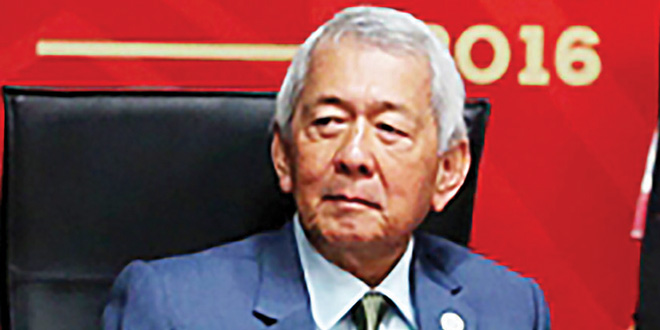
The postponement of the visit to Manila of Chinese Minister of Commerce Gao Hucheng was not in retaliation for the statement of Foreign Secretary Perfecto Yasay on the Chinese militarization of the South China, but was due to new appointments in the Chinese government, Trade and Industry Secretary Ramon Lopez said.
“They (China government) already announced the new commerce minister. That’s why the visit was postponed,” Lopez added.
At the sidelines of the Philippines-China Investment Forum in Makati City on Friday, Philippine Ambassador to China Jose Sta. Romana also said the new appointments made by the Chinese government was the reason for the cancelled visit of Gao in the country, and not Yasay’s statement during the Asean ministers’ meeting on Boracay island, preparatory to the Asean summit. “It had something to do with Chinese politics,” Sta. Romana stressed.
During the investment forum, Chinese Ambassador Zhao Jianhua said the new commerce minister would visit the country to sign guidelines of cooperation between China and the Philippines.
“It is a very important part for the coming visit of the new minister of commerce of China. He will sign, together with his counterparts, guidelines which would guarantee that proper and legal procedures to be followed. Cooperation between both sides would be rules-based, transparent, and will stand the test of time, stand the test of laws,” Jianhua said. Meanwhile, taking over the (Ministry of Commerce) of China leadership is its current Vice Commerce Minister Zhong Shan, who was previously an international trade representative of China.
Tycoon and former envoy Francis Chua said Zhong would visit the Philippines on March 7. The postponement of Gao’s visit was earlier seen as the upshot of a statement of Foreign Secretary Perfecto Yasay in a meeting of Asean ministers that the regional bloc has “grave concerns” over the Chinese government‘s militarization of the South China Sea.
The “offending” remarks were made by Yasay in a speech in Boracay last Feb 21. It gained significance when Mr. Duterte referred to this in a speech on Feb. 24, saying China may have misunderstood Yasay’s comments about militarization in the South China Sea.
China has made no direct reference to it but at a press conference, Chinese Foreign Ministry Spokesman Geng Shuang said that, “Due to some scheduling issue, the China-Philippines joint commerce committee meeting will be postponed for some time. China and the Philippines are making preparations for that.”
Chinese Commerce Minister Gao Hucheng’s trip to Manila, scheduled for this week, has also been suspended for similar reasons, added Geng. Geng then spoke of the significance of Mr. Duterte’s visit last year to China as transforming ties between the two nations, which otherwise were embroiled in disputes over the South China Sea. “During that visit, the two sides signed a series of cooperation agreements, now with the joint efforts of both sides the agreements are turned into reality by both sides,” said Geng. During the visit, China agreed to invest around $15 billion in the Philippines, and these cooperation agreements continued to progress in January during another official visit by a Philippines delegation to China. Mr. Duterte, seeking to clarify the issue, said China may have misunderstood Yasay’s comments about its militarization in the South China Sea. In a speech in Davao, the President said he wanted solid ties with China and there was no urgency in pressing it to abide by last year’s arbitration ruling on the Philippines’s maritime boundaries and sovereign rights, which went in favor of Manila and infuriated Beijing. Mr. Duterte stressed that what he told China President Xi Jinping in a meeting early this year that “he would raise the Permanent Court of Arbitration (PCA) award to China” during the course of his presidency but not at this time.” The President said the Chinese government apparently “misunderstood” Yasay’s statement.
Said Mr. Duterte: “I would like to assure China, and this is what I had committed to do when I was there, that we will talk as friends.”
Mr. Duterte said he is keen on tapping China for loans, tourists and infrastructure. He added the Philippines’s longstanding alliance with the United States did not make it “duty bound to follow” Washington’s foreign policy, and that conflict with Beijing was not an option. “We cannot go to war because we cannot afford it,” he said. “And as much as possible, the bilateral relations between the two countries would be enhanced and improved and trade and commerce between the two countries greatly improved,” he said. But that could be affected by Yasay’s comments that Asean members were “unanimous in their expression of concern” about “very unsettling” developments. Yasay mentioned China by name, something the 10-nation grouping is often reluctant to do. China’s Geng said Yasay’s remarks were “baffling and regrettable,” and that he hoped Yasay would “speak and act cautiously.”