 The Market Monitor Minding the Nation's Business
 In a baby-marsupial way, the little boy clung to his grandmother, when presented to my mother, then a grade school teacher, midway in the school year—not only in hopes he could continue schooling but also to regain his speech that he suddenly lost, as the elderly woman implored.
Recalling that morning, my mother had described the lost and fearful eyes of the little boy; his parents had died in an accident, just two weeks before then, and taken on his first bus ride from Isabela to his grandmother in another province, where strangeness must have fed on questions beyond a mind, yet focused on his top, which my mother remembered he held on to, and more so, words he seemed to have swallowed.
A “double orphan”, that’s how he would have been listed, if tracking down orphans were practiced then, in the ‘50s, or one among recent global estimates by Unicef and the US, up by an overwhelming 17.8 million of them worldwide, and 153 million, if “single (parent) orphans” were added. Quite a sad kind of sorting, for me, though, to whom “orphan”—mentioned as far back as in biblical texts (along with widows) 76 times—would fail to discern who belongs where.
Such “broader definition” that Unicef and numerous international organizations adopted, has been prompted apparently, by the ‘80s AIDS pandemic, which caused parental deaths in millions worldwide. With wars and terrorist attacks crisscrossing regions today, and aftermaths of danger-laced waves of forced migrations, as well as calamities descending on populations in such seeming fury that defy forecasts, why wouldn’t orphans like wild seeds seem to sprout endlessly among us?
Also, up close, as admitted in the same source, the above data fails to include children “who are living on the streets, exploited for labor, victims of trafficking, or participating in armed groups.” From them, “social orphans”, of which children in orphanages belong, estimated from 2 to +8 million, has been added to the terminology—yet, still missing in this numbers-cloud, would be virtual orphans living with one or both parents, as if they did not.
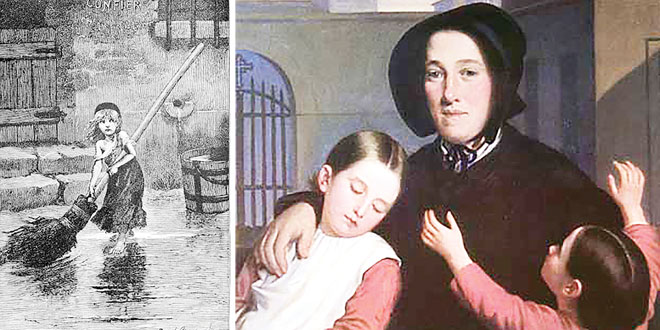
Because the word, “orphan”, also implies lack of (or freed) status, such fragile quality—in truth, a raw vulnerability—leaves orphans prey to “servitude”, and even “slavery”, as we know so well. In art as in reality, such truth pervades: Think Oliver Twist, who ended up with ruthless Fagin’s cadre of clever pickpockets, from Charles Dickens’ novel turned into a musical, or Cosette, left by a bereft mother in the care of a supposed-friend, who abused and enslaved her, also a musical adapted from Victor Hugo’s Les Misérables.
While both draw out in the flesh 200-year old realities and still chop the heart in quarters, present-day encounters grind us to pieces—orphans here in North America, shuttled from one foster home to the next, with siblings often separated, hence, intensifying their sense of loss, for one. As well, street children in Manila, orphaned not by natural calamity, disease or war but by an alcoholic mother, who has abandoned them to merciless streets, taking on, or possibly forced by a local Fagin into craftier roles as beggars, a whimpering baby (probably borrowed or stolen) strapped to the waist, and knocking with a doleful face, on car windows. So many other images have haunted hearts through vast histories, yet the swarm always seems new.
Indeed, thoughts on them do weigh us down to despair, conscious that more than normal needs, their cleaved spirit, surely like what ailed the boy, who turned mute, should be addressed. That most governments with private institutions ensure their freedom and most rights, though often insufficient, certainly, echo, for me, God’s handing over to Israel the care of the poor, especially, orphans and widows, when asked how best to repay him. As well, Muslims, who identify them by the Arabic word, “yateem”, meaning, “those left behind”, would be bound by a long list in the Qur’an on how to treat them, and understandably so, with Mohammed, himself orphaned at six years old, according to the Alyateem website.
I used to wonder how old orphans should be. The answer, which I recently found: Up to age sixteen or not beyond the years, when a child turns into an adult. But, having known intimately mostly mothers and grandmothers, wont to meditate on their hands or on a flailing leaf, sinking into inner wordless spaces, where like the little boy that my mother took to her class, a stinging sense of orphan-hood apparently remained unhealed, no matter their years.
From later stories of my mother, I learned that the boy recovered his voice, but hardly ever asked about his parents. Speaking of voice, a poignant moment has long stayed with me, about another ulila, who, as he spoke at the installation of his father’s bust, when hailed as hero of their town, someone said, “He has his father’s voice”; one, of which this son, orphaned at age three, I bet, has been unaware that he carried into a newscaster’s studio, booming in newsrooms, and singing through many moons on Press Club nights.