 The Market Monitor Minding the Nation's Business
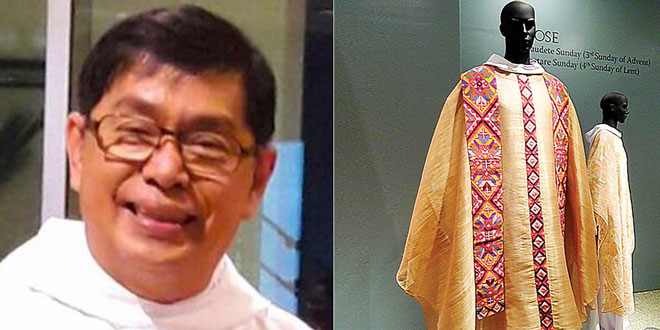
By Albert-Anthony Abando / Philippine News Agency
Sixty liturgical vestments from 20 ethnolinguistic groups in the Philippines are now on display as part of a recently opened exhibition at the Ayala Museum in Makati City.
The exhibition, titled Vestments for Worship: Wrapped in Identity, showcases the designs of Benedictine monk Dom Martin Hizon Gomez, OSB from the Abbey of the Transfiguration in Malaybalay City, Bukidnon province.
Gomez studied at the SLIMS Fashion and Arts School from 1967 to 1968 and had a 22-year career as a fashion designer before entering the monastery.
The Roman Catholic Church recently adopted the concept of “enculturation”, which means that songs—and now vestments—can be indigenized. Vestments can make use of fabrics belonging to the cultural identity of each parish.
Amazed by the country’s rich cultural heritage, Gomez was prompted to ask: “We have all these beautiful materials. How come we never use them for the Church?”
He, however, had to make certain that fabrics and other ornaments from the various ethnolinguistic groups in the country remain available.
“If I am going to promote the use of indigenous materials, I should be assured of the supply. I know they are beautiful, but do people still weave them? I might be creating a market, but then all of a sudden, there might be no supply,” Gomez said.
Acting as his own researcher and anthropologist, the former designer embarked on a journey that took him from his native Mindanao to the northernmost parts of Luzon in search of the best materials that would represent the ethnolinguistic groups of the Philippines.
It was a project that took him four-and-a-half years to complete. Gomez traveled and studied the 20 ethnolinguistic groups to make sure they are still weaving and can weave for the Church.
In this regard, the monk sought the help of the Philippine Textile Research Institute (PTRI); the Fiber Industry Development Authority (Fida); and the Katutubong Pilipino Foundation, whose chairman, Margie Macasaet, encouraged him to create a whole collection in time for the Philippine Centennial celebrations in 1998.
He also checked with his embroiderers in Parañaque and Las Piñas cities to see if they were still around and working. They were only too glad to help with his project.
“I was very blessed that all the people I approached believed in what I wanted to do—to enculturate liturgical vestments and make them Filipino,” Gomez said.
While doing research in the field, the designer-turned-monk realized how remote and inaccessible some of these indigenous groups were, including the Itneg tribe in Abra, which he reached after a long trek that included crossing a hanging bridge over a raging river.
“Two days later, when I came home, I talked to my brother and I said, please get me an insurance policy. I did not realize this research was going to entail some danger,” he said.
The resulting pieces were nothing short of breathtaking. The vestments were done in a variety of fabrics, including abaca and piña, and incorporated the colors of the Itneg, Gaddang, Ifugaos, and many other indigenous peoples.
Each piece is entirely done by hand. The ornaments and embroidery work are intricate and exquisite, and incorporated such liturgical symbols as the cross, vines, and branches.
According to Gomez, the simplicity of the vestments in the early days of Christianity signified that the Church closely identified itself with the poor. This explains why he left out symbols on the stole—stola in Greek, which means “towel”.
“You do not put symbols on top of symbols. In the early ages, all of these vestments were ordinary clothing. The stola was just a towel that the men used to wipe their faces and hands,” the monk explained.
”Later on, they had to put emblems and different symbols for catechetical instruction. It served its purpose in those years, but at this point in time, they are not strictly necessary, which is why my stoles do not have additional symbols,” he said.
We have to take pride in our heritage and culture, and bring this pride and culture into our liturgical celebrations, according to Gomez.
”Only then can we say that our worship has become truly Filipino. Enculturating vestments is very important because when a priest celebrates the Holy Eucharist wearing a vestment using indigenous materials, he is not only clothed for worship, (but also) wrapped in the Filipino identity,” he said.
Vestments for Worship: Wrapped in Identity runs at the Ayala Museum until July 23, 2017.