 The Market Monitor Minding the Nation's Business
By Luis Leoncio
Economic managers and other Cabinet officials were ordered by President Duterte to hasten spending or else lose their jobs.
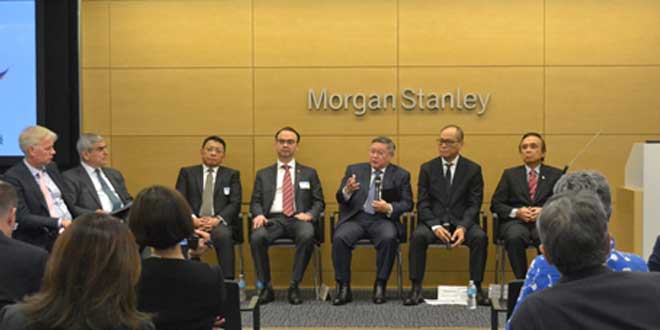
In a presentation to a briefing at the Morgan Stanley Headquarters in New York City, Budget Secretary Benjamin Diokno said that the former policy dictum of use it or lose it referring to the budget allocations has been expanded by Mr. Duterte “to use it or lose your job.”
“The President has a strong message for the spending ministers – use it or lose it, not lose your budget, lose your job,” he said.
Diokno also reiterated the reforms the DBM undertook to boost spending— use of technology, shift to cash appropriations, one year appropriation shelf life, among others.
Diokno discussed the expansionary fiscal policy, as well as salient points in the budget.
He also emphasized legislative agenda and administrative reforms pushing for greater budget transparency and reliability.
“For the first time, the national budget will follow a program-based budgeting structure for FY 2018, for better linkage in planning and budgeting as well as transparency and better monitoring of projects that are funded by our taxpayer’s money,” Diokno said.
After the economic managers gave their presentations, they were joined by private sector representative Jaime Augusto Zobel de Ayala, CEO and Chairman of Ayala Corporation, for a panel discussion and open forum moderated by Jay Collins, Vice Chairman for Corporate and Investment Banking for Citigroup.
During the moderated discussion, Diokno was asked how the current administration was able to curb underspending in such a short period of time.
The budget minister was also asked what the perceived advantages are for Hybrid Private-Public Partnership (PPP), the administration’s preferred mode of infrastructure development, over Traditional PPP, and the role of the private sector given this arrangement.
According to Secretary Diokno, financing and planning – ‘feasibility studies and detailed engineering’ – will be done by the government, while construction and operation and maintenance will be bid out to the private sector.
“[The Build, Build, Build team] would like to argue (hybrid PPP) takes less months to mount and is less expensive than the traditional PPP,” he said. “Traditional PPP it takes 29 months from project Identification until the first shovel hits the ground.”
He also said that use of facility will be more affordable with the public sector shouldering costs.
“With hybrid PPP, the cost of financing is lower, say in the neighborhood of 2%, long term, say 30 to 40 years.. Which private company can borrow under those terms?”
The budget minister also shared two other key differences between the project approval and financing arrangement under this administration and the previous administration – first, that they are open to unsolicited proposals, subject to Swiss challenge, and second, that PPP projects will not be used as a way of raising resources for the government.
“The previous administration would grant a project to a contractor who can offer the highest premium. That’s tantamount to “taxation without representation” and a sure guarantee that the user charge to a facility is much higher than the full costs of the project,” Diokno said.
Economic managers took the opportunity to give the briefing to US-based portfolio and direct investors on their way to World Bank-IMF Annual Meeting in Washington D.C. The briefing was organized by Bangko Sentral ng Pilipinas, Morgan Stanley, Deutsche Bank, Citibank and Standard Charter Bank.
The great strides in public governance and the economic reforms under the administration of President Duterte would convince more American businessmen to invest in the country, Finance Secretary Carlos Dominguez III said in a separate forum.
In a forum on the Philippine economy organized by the Center for Strategic and International Studies (CSIS), Dominguez also updated US policy makers, and leaders from the American private sector of the Philippines’ robust economic performance and the Duterte administration’s plans to realize its expansionary economic strategy and inclusive growth agenda through reforms in the tax system and accelerated spending on infrastructure and social services, among other measures.
Dominguez said the Philippines has managed to accomplish much in, among others, modernizing governance, improving policy formulation and strengthening the rule of law with the sustained support of the US government.
“The support likewise covers winning peace and progress for Mindanao, facilitating trade and modernizing our agriculture. With the help of generous development assistance from the US, we have accomplished much,” Dominguez said at the event held at the CSIS Building in Washington DC.
The CSIS, a bipartisan, nonprofit policy research group provides proposed policy solutions to current and emerging global issues.
CSIS is headed by John Hamre, a former deputy secretary of the US Department of Defense. This private think tank, which has a contingent of policy experts in various fields, is regularly called upon by the US Congress, the White House and the media to offer recommendations on improving US strategy on a wide range of global concerns.
In this CSIS forum on the Philippine economy, Dominguez expressed the hope that “improvements in our governance and a benevolent conjuncture of factors favoring stronger growth will encourage private investments from the US to take a much closer look at our economic prospects.”
Dominguez likewise underscored the strong partnership between the Philippines and the US that is “tested by time and made more enduring by the shared values we hold.”
“Let me say that the partnership between the Philippines and the US can only grow stronger in the coming period,” he said.
He said the Philippine government’s massive investments in education, training, health care and other social services, will be supported in part by the first phase of the Duterte administration’s proposed tax reform program, which is expected to be approved by the Congress later this year.
Besides allowing the government to increase spending on human capital development, Dominguez said reforming the tax system will also enable it to invest massively in infrastructure without compromising the country’s fiscal position.
The Duterte administration, Dominguez said, is planning to spend $20 billion each year through the medium term to build its urgently needed infrastructure.
“We are optimistic and we are committed. We are confident we have the correct strategy and moving in the right direction. We will continue to rely on your support in this grand effort to reduce poverty, build strong institutions and properly care for the most vulnerable among our people,” Dominguez said at the CSIS forum.
Dominguez said the Philippine economy has become “an engine of growth” in Asia, with its second quarter gross domestic product (GDP) expanding by 6.5 percent, which is well on track in meeting the full-year target growth rate of 6..5 to 7.5 percent.
An even more significant development, he said, is that GDP growth was led by the industry sector at 7.3 percent, and agriculture at 6.3 percent, which is a “departure from the earlier pattern where growth was led by the services sector.”
He said “investment-led growth will make our domestic economy more inclusive and create quality jobs for our people,” which would, in turn, help bring down poverty incidence from the current 21 percent to 14 percent by 2022.
Dominguez cited the government’s continuing efforts to improve the ease of doing business by cutting red tape, curtailing corrupt practices and limiting its negative list for foreign investments, and training the country’s young and talented workforce to be more globally competitive, as among the factors that would sustain the Philippine economy’s high growth and haul in more long-term investments.
He said a benign interest environment encouraged the Philippines’ property development boom and increased business activity, while pulling down the country’s public debt to “more than manageable levels.”
“This produced a virtuous cycle. The lighter debt load won us better credit ratings that in turn helped us keep interest rates low,” he said.
Despite the increased spending on infrastructure and social services, Dominguez said the Philippines expects inflation to hover just between 2 percent and 4 percent through the medium term.
On the Duterte watch, public sector deficit will be limited to 3 percent of GDP and an 80-20 ratio on loans in favor of domestic borrowings will be a matter of policy to lessen foreign exchange risks, he said.
“Over the past few years, our GDP grew faster than our debt accumulation. Prudence dictates that we strive to maintain this trend. Fiscal stability is key to the sustainability of our economic expansion. We are further modernizing our capital markets to enable the consolidation of capital to support long-term growth,” Dominguez said.
Earlier, in New York City, Dominguez told the American business community that the Philippines has started to deliver on its anticipated economic breakout on the Duterte watch, turning into one of Asia’s engines of growth despite the political noise and the recent terrorist attack in Marawi City.
Dominguez said at a briefing on the Philippine economy for potential US-based investors that the Philippines expects greater foreign direct investment (FDI) inflows in the years ahead as the Duterte administration steps up its efforts to modernize infrastructure and reform business policies meant to sustain the growth momentum, create more jobs, attack poverty and achieve a more inclusive economy.