 The Market Monitor Minding the Nation's Business
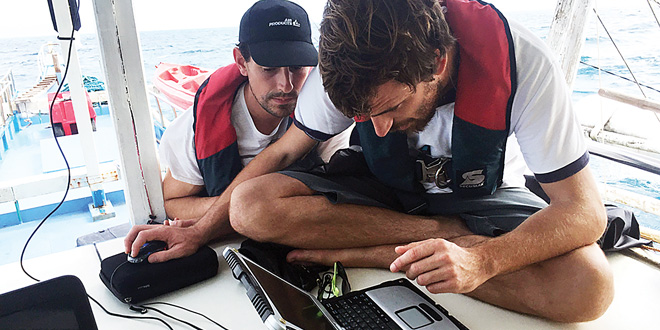
A Filipino-French joint venture building a $25-million pilot phase of an ocean tidal power plant in San Bernardino Strait, which will be the first in the Philippines and the Asean region, encouraged the government to create a single state-run guarantee agency to provide assistance to major projects.
By integrating the four guarantee agencies, the country will be in a better position to finance developmental projects by the private sector, Finance Secretary Carlos G. Dominguez III earlier said.
“Ocean power needs strong government support. The kinetic energy of tidal currents produces stable electricity supply. This is real ‘grid smart’ technology because it can provide steady ancillary service supporting the transmission of electricity from generation to customers up to far-flung areas,” H&WB Asia Pacific (Pte Ltd) Corp. president Antonio Ver said.
San Bernardino Ocean Power Corp. (SBOPC) is the special purpose company of H&WB and French marine energies’ technologies and engineering company Sabella Société par Actions Simplifiée (Sabella) for an ocean power plant project aimed to boost the renewable energy portfolio of the country.
Ver said the government’s plan to establish a single government guarantee system, which was endorsed in October by the Governance Commission for Government-Owned or -Controlled Corporations for President Duterte’s approval, will bolster the chances of SBOPC getting the international funding.
“The ADFD loan facility is an effective financing strategy for the San Bernardino ocean power plant and securing the funding will certainly accelerate the construction and development phases of the project and jumpstart the development of ocean energy,” Ver added.
He said the plant is a “scalable proof of concept” that would allow ramping up tidal in-stream energy conversion (TISEC) technology, an ocean power technology mostly adaptable, or the technology-of-choice, in Philippines waters.
The pioneering project was shortlisted in May 2017 for possible financing under the fifth funding cycle of the International Renewable Energy Agency/Abu Dhabi Fund for Development (IRENA/ADFD).
However, ADFD requires a government guarantee letter and eventually a guarantee agreement for loan applicants that are private entities such as SBOPC.
In its report entitled “The Renewable Readiness Assessment, The Philippines,” IRENA has recognized the abundance of ocean energy in the country due to its inherently archipelagic geography. The report also cited the San Bernardino Strait project.
The project is also consistent with the Philippines’ climate change initiatives.
In a show of commitment to the groundbreaking project, H&WB and Sabella officials will attend the historic “One Planet Summit” on December 11 to 12 in Paris, France.
Billed as a follow-up to the landmark Paris climate accord reached in 2015, the Summit is expected to gather around 2,000 people from government and the private sector from more than 100 countries to focus on financing to combat climate change.
The project seeks to provide reliable and clean power supply initially to 25,000 people living in the island of Capul, which is off-grid under the Small islands Power Utility Group of the state power firm National Power Corp (Napocor).
The remote island solely relies on obsolete, costly, and polluting diesel generators for electricity.
Northern Samar Electric Cooperative (NORSAMELCO) will be the off-taker for an initial 1.5-megawatt power plant harnessing the marine current resource in San Bernardino Strait, which separates the islands of Luzon and Samar.
The project will be implemented in phases: Napocor diesel generators will be operated in tandem with the tidal turbines under a hybrid scheme until the island is weaned from SPUG.
Napocor currently supplies 60 percent of Capul’s electricity at not more than eight hours a day.
Once operational, the ocean power plant will become a Qualified Third Party (QTP), which will handle both electricity generation and distribution to sustainably energize the entire island.
The project could spur economic development in nearby municipalities of San Antonio and the major towns of the provinces of Sorsogon and Northern Samar within SBOPC’s concession areas when power is switched-on.
The capacity of the tidal farm increases to electrify Calintaan and Matnog in Sorsogon that have a demand of up to 20 megawatts (MW) for the next three years.
The project has undergone public consultation with the Renewable Energy Management Bureau of the Department of Energy last October 24 in Capul.
PNOC Renewable Energy Corporation has also signified its interest to invest in the project. Capul’s local government and communities have been supportive of the project toward reaching its fulfillment.
The Renewable Energy Management Bureau (REMB) of the Department of Energy (DoE) held a successful public consultation with San Bernardino Ocean Power Corp. (SBOPC) and PNOC Renewables Corp last October 24 in Capul island, Northern Samar.
Sabella Société par Actions Simplifiée (Sabella) of France will deploy a resilient marine turbine that will use tidal in-stream energy conversion (TISEC) technology, an ocean power technology mostly adaptable in the Philippine waters. The power plant expands to 3 megawatts (MW) with a 1-MWh storage.
The capacity of the tidal farm is scalable to electrify Calintaan and Matnog in Sorsogon that have a demand of up to 20 MW for the next three years.
The project is envisioned to benefit the nearby municipalities of San Antonio and the major towns of the provinces of Sorsogon and Northern Samar within SBOPC’s concession areas. San Bernardino Strait’s tidal currents have a 500-MW potential. Tidal currents are predictable, and produce massive kinetic energy to run marine turbines.
“TISEC could be the technology of choice in ocean renewable energy development in the Philippines,” Ver said.
Sabella, a leading marine energies’ technologies and engineering company, develops TISEC and is reputed for its successful project using its D-10 turbine in Fromveur Passage in energizing Ushant, an off-grid island in Brittany, France. Sabella chairman and president Jean-Francois Daviau is a strong advocate of a “Fossil-Free Island” (FFI) in Europe.
The project is in support of Energy Secretary Alfonso G. Cusi’s vision to prioritize the electrification of unserved areas and raise the country’s renewable energy mix.
RIZA LOZADA