 The Market Monitor Minding the Nation's Business
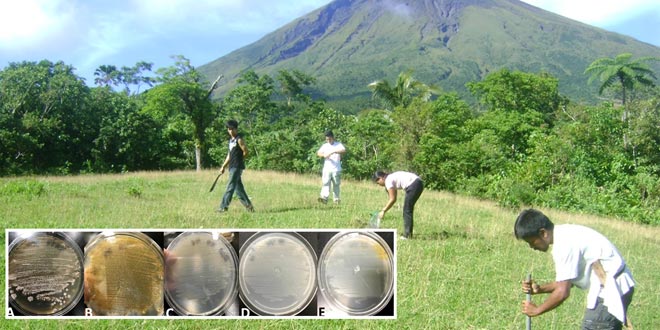
Local scientists have discovered that the soil spewed out by Mayon volcano over the last 47 times it erupted (since 1616) contain life-saving elements with anti-cancer properties.
The Department of Science and Technology (DOST) announced that researchers from the University of the Philippines Los Baños (UPLB) have identified a species of bacteria from the soil of Mayon.
The researchers isolated 30 bacterial species from soil samples in Malilipot, Albay, which is near Mayon. At least 13 of these showed varying antibiotic activities against known human and plant pathogens.
But one of the isolated bacteria from Mayon’s soil, called streptomyces sp. A1-08, showed “antibiotic activity against numerous potentially pathogenic microorganisms and anti-colorectal cancer potential.”
The species, in general, are known to produce medically and pharmaceutically important products.
“We have high hopes of getting new and novel species,” said Kristel Mae Oliveros, leader of the project and assistant professor at UPLB’s Microbiology Division.
She said the scientists are “totally surprised and excited” at the results of their experiments. Her team is composed of Albert Remus Rosana, Dr. Rina Opulencia, Asuncion Raymundo, the late Dr. Teofila Zulaybar, Arian Jacildo and Andrew Montecillo.
Rosana, PhD student at the University of Alberta, Canada, said that once the streptomyces sp. A1-08 was confirmed to be a new species, the team would name it “streptomyces mayonensis A1-08” in honor of the Philippine’s most active volcano.
In 1949, Dr. Abelardo Aguilar, a Filipino scientist, discovered an antibiotic derived strain of bacteria found in his backyard.
He isolated the strain which led to the development of erythromycin, an antibiotic that is used to treat a wide variety of bacterial infections.
The discovery in Albay by Oliveros’ team was the latest breakthrough in the Philippines following several significant findings in previous years.
In 2019, researchers from the University of the Philippines Baguio were able to discover four strains of bacteria capable of biodegrading low-density polyethylene (LDPE) in Zambales. LDPE is used for plastic bags, bottles of shampoo, and plastic containers.
Dr. Marian de Leon, in 2015, observed the Cabalyorisa Cave in Pangasinan where she was able to stir the possibility of isolating and characterizing novel bacteria like streptomyces sp. strains AC1-42T and AC1-42W which are capable of producing antibiotics and enzymes.
A research that was funded by the National Research Council of the Philippines likewise discovered microorganisms from sediments collected from the ocean floor which demonstrated an ability to kill bacteria that had developed resistance to antibiotics.
Since the 30 isolates thrive in a unique environment such as volcanic soil on Mayon, the researchers believed that they could most likely produce unique chemical compounds that may have medical, pharmaceutical, and even cosmetic uses.
However, the streptomyces sp. A1-08 stood out because it showed the ability to fight harmful microorganisms and the methicillin-resistant staphylococcus aureus, or MRSA, that is strongly resistant against antibiotics which makes treatment of infections more difficult.
Oliveros said that the team wanted to screen actinomycete isolates for antimicrobial activity so “we ensured that our selected test organisms would represent some of the major groups of microorganisms, including bacteria, yeasts, and molds to capture a broader antimicrobial spectrum result.”
Rosana explained that the choice of test organisms was also associated with the World Health Organization’s (WHO) list of human pathogens that will endanger human health by 2050 mainly because they were resistant to antibiotics.
The WHO has declared antimicrobial resistance as fifth on a list of 10 threats to global health.