 The Market Monitor Minding the Nation's Business
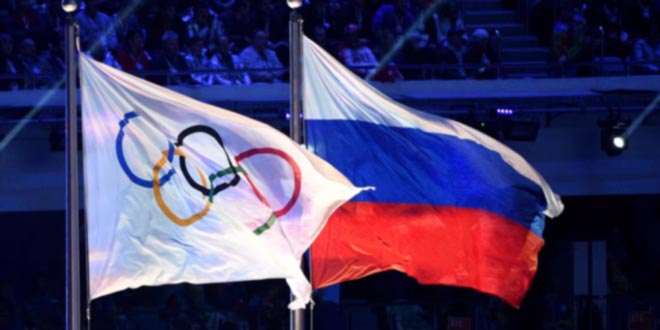
While Russia continues its bloody invasion of Ukraine, sports has again become intertwined with world politics.
History shows that Germany was banned from the Olympics after World Wars 1 and 2. South Africa was long a sporting pariah over its apartheid system. The United States boycotted the 1980 Moscow Games as retribution for the Soviet invasion of Afghanistan.
“It’s naïve for anyone to think sports and politics don’t mix at all,” Olympic historian Bill Mallon said. “In an ideal world, they wouldn’t. But I don’t know how you get around it.”
When Germany and its allies were banished from the Olympics after World War I, it hardly prevented an even more horrifying World War II less than two decades later.
Adolf Hitler used the 1936 Summer Olympics to score major propaganda points for a regime that was already on a clear path to igniting World War II.
South Africa was first banned from the Olympics in 1964, but it would take another quarter-century for its evil system of racial segregation to fall — and there’s little to indicate that sports played a major role in the epic transformation.
“I don’t think the boycotts contributed to the end of apartheid,” said Angelo Fick, a political analyst in South Africa.
The US Olympic boycott of 1980 resulted in the Soviet Union launching its own boycott of the Los Angeles Games four years later. The Soviets didn’t bail out of Afghanistan until 1989.
That’s not to say the International Olympic Committee (IOC) and other major governing bodies were out of line when they quickly ousted Russia and its accomplice, Belarus, for waging a seemingly unprovoked war against a neighboring country.
“I don’t think it has that much influence,” said Usha Haley, a professor of at Wichita State University who extensively studied the effects of sanctions in South Africa. “Yes, there’s a symbolic influence, and symbolism does matter. Appearing righteous does matter. But will it actually change anything? That’s unlikely.”
Mallon predicts that Russia will try to launch its own Olympic-style games if the IOC ban remains in effect into the 2024 Paris Games.
In 1936, a People’s Olympiad was planned for Barcelona to protest the Summer Olympics in Germany, drawing support from athletes as well as the Soviet Union.
The outbreak of the Spanish Civil War scuttled those plans, and the alternate Olympics became a footnote in history when World War II broke out three years later.
Mallon points to another Olympic-style event that did actually get off the ground in the midst of the Cold War.
After being suspended by the IOC over its politically charged hosting of the 1962 Asian Games, in which Taiwan and Israel were denied entry, Indonesia launched its own sporting organization, GANEFO – Games of the New Emerging Forces.
Indonesian leader Sukarno, who declared the Olympics to be “a tool of the imperialists and colonialists,” welcomed 51 nations to the inaugural GANEFO in 1963, though many did not send their top athletes for fear of reprisal from the IOC.
China, which at the time was not recognized by the IOC, dominated the medal table. A team from “Arab Palestine” also participated.
An Asian-only GANEFO was held in 1966, but plans for another full-scale games the following year in Cairo, Egypt, were scuttled.
Mallon foresees Moscow putting together some sort of GANEFO-style games in 2024 if the Olympics are off limits.
Countries such as Belarus, Syria and North Korea would likely participate, Mallon said, including China and India which have been reticent about fully condemning the Ukraine invasion, sending teams to a Moscow-led competition even if they’re also taking part in the Paris Games.