 The Market Monitor Minding the Nation's Business
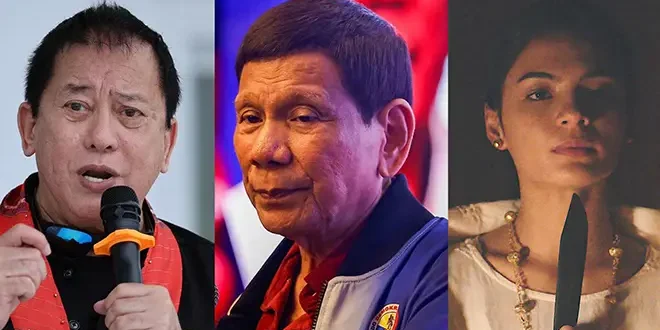

I wonder how National Artist for Film Lino Brocka would react if he were alive today about the arrest of former president Rodrigo Roa Duterte.
Lino who was an anti-fascist, first and foremost, as a person and secondly, as a citizen of the republic.
Most of all, Brocka was a freedom fighter as an artist.
Remember that during the fierce dictatorship of the Martial Law era, the progressive director was one of the organizers—together with fellow activists and artists Bienvenido Lumbera (now National Artist for Literature), theater stalwart as well as movie director Behn Cervantes (among other nationalists, like actress Bibeth Orteza, entertainment editor Jo-Ann Maglipon, scriptwriter and literary giant Jose F. Lacaba etc.)—of the Concerned Artists of the Philippines (CAP) to uphold and protect the artistic and economic rights of artists as individuals.
Lino was a militant filmmaker who fought for national liberation and sovereignty.
His melodramatic works were expressions of social analysis, its ills and cures to society’s ailments.
What he defied against are the same grievances of current protesters against establishments which are harbinger of social injustices, exploitation, oppression, unequal distribution of wealth, inequality among classes, to name only a few.
I could imagine Lino at this time of chaotic Philippines—political bickering, economic collapse, corruption in high and low places, arbitrary censorship etc. He wouldn’t just sit in one corner and watch history unfold serving only a few. He would be part of the call for change. He would join rallies and dialogues to enlighten the minds of the people, especially the poor, of what really is happening around to their advantage, thresh out problems and offer solutions.
Brocka didn’t want to document history long gone but he wanted to film the immediate past right here and then.
Surely, the director would quickly record in film or video what has immediately happened, like for instance, the Duterte arrest.
FPRRD was apprehended by means of a warrant of arrest issued by the International Criminal Court (ICC) which was coursed through the Interpol.
While DU30 was charged with crimes against humanity and according to international law, the cases involved here are murder, extermination, sexual violence, genocide, enslavement and other offenses.
The case filed against Duterte is in connection with his bloody war on drugs during his tenure as mayor of Davao City in 2011 and his presidential leadership in 2019 before he or the country through his gambit quit membership of ICC.
DU30’s arrest and the circumstances surrounding it are indeed cinematic or rich in storyline for creative non-fiction or a biographical sketch meant for a biopic.
A slice in DU30’s life is enough material for a full-length project.
It was writer Danton Remoto who remarked immediately after the arrest that Duterte’s story is as colorful as the Colombian fictionist Gabriel Garcia Marquez’s novel “Autumn of the Patriarch.”
Let’s focus yet on the big screen material.
To add color to it, various personas navigating around him can make a more interesting narrative.
To begin with, the Marcoses and the Dutertes with their minions are supporting personages to lend depth and width to his giant characterization.
The setting—time and space—can also speak volumes of truths about the man that can crystallize the movie’s theme, conflicts, atmosphere, point of view, texture, design, sound, camera works, editing and other elements of film.
If not a feature, a documentary film is also a good vehicle to present a wide array of images and soundbites on the arrest chapter.
Because a doc can dig up a lot of issues with corresponding devices to come out as objective as possible, various sides to them can be presented.
Interviews with the pro and anti is a must.
The inclusion of the families of the victims who were killed or those who are still living witnesses of “Oplan Tokhang” can shed light on the issue. They are also central characters, to begin with.
Who knows many of the families of the Extra Judicial Killings (EJKs) would say that it’s high time that their real, big stories be heard if not headlined in most multimedia platforms unlike the usual stuffs on the Marcoses and the Dutertes whose discourse on the political maturity of the Filipinos contribute to the mediocrity if not one-sidedness of the subject because instead of discussing the real causes of drug menace, one of them, poverty, the news focuses on the family feud of the two political clans leaving out the meatier stories of the poor people who are also hot copies.
Cathy Sanchez-Babao, daughter of actress Caridad Sanchez, has conveyed the sentiments of one of her male classmates in cultural anthropology in graduate school. Kin to a victim of EJK told the class and recorded by Cathy.
“’My classmate shared he had lost a cousin to an EJK and that it was difficult not to be biased or be triggered by the events that were unfolding. But what he said next made all of us pause. ‘I understand all sides. Both victims and supporters are on the losing end here. The war on drugs was really a war against the poor’,’” echoed Sanchez-Babao.
Indeed, eradication of poverty is the main issue here.
Our choice for the lead actor to portray Digong in the feature film?
Phillip Salvador, no less.
Getting him wouldn’t be a problem because they’re allies
What happened then to Robin Padilla who’s also a Duterte follower?
Well, he can play BBM.
For the documentary version, real characters and events are the protagonists themselves.
***
Lovi Poe is in town not only to do a TV drama but to help promote a very significant film project she starred in which is meant to screen during a sesquicentennial celebration of life of a national heroine.
Lovi is part of the docu-drama “Lakambini Gregoria de Jesus” which started as a feature film but because of several limitations, turned into a palatable creative documentary collaboratively and masterfully crafted by artists Ellen Ongkeko-Marfil, Arjanmar Rebeta, Rody Vera and Jeffrey Jeturian.
Poe is one of the epochal characters of Gregoria de Jesus who is also played in various life stages by Gina Pareno and Elora Espano with Rocco Nacino as Andres Bonifacio.
“Lakambini Gregoria de Jesus” will be shown in May as a tribute on the 150th birth anniversary of Ka Oryang.