 The Market Monitor Minding the Nation's Business

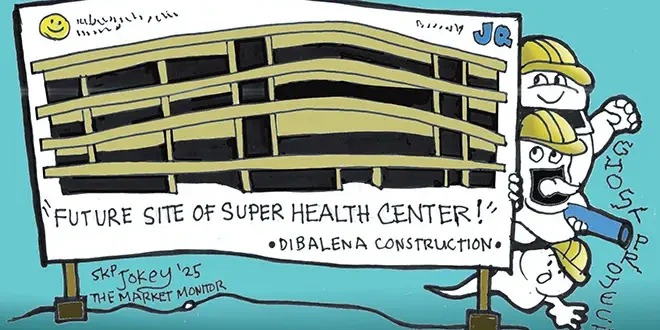
In any functioning democracy, accountability is a non-negotiable pillar. But in the Philippines today, what we are witnessing is not merely a failure of governance — it is a state of systemic impunity that has turned corruption into policy, and incompetence into spectacle.
The Department of Education has raised alarm: only two new classrooms have been built this year by the Department of Public Works and Highways (DPWH), despite appropriatedbudget. Two classrooms in a nation of over 27 million students — this is not a clerical error; it is an insult.
But this isn’t an isolated failure. The Department of Health has now presented evidence to the Independent Commission on Infrastructure (ICI) showing “ghost” Super Health Centers —facilities that exist only on paper, courtesy again of the DPWH.
In any other country, such a scandal would prompt resignations, arrests and public outrage. Here, it prompts press briefings and another round of finger-pointing.
Senate President Tito Sotto has announced that Sen. Ping Lacson will return as chairman of the Senate Blue Ribbon Committee to resume investigations into flood control projects. If that sounds familiar, it’s because it is. These investigations never end — they simply loop, year after year, administration after administration, with little to show but thick transcripts and thicker layers of dust. No major player is ever convicted. No plundered peso is ever returned.
And now, the United States is watching. A representative from the US Embassy has requested a briefing on the ICI’s findings, signifying growing international concern. Corruption of this scale no longer hides within national borders; it leaks into global forums, embarrassing the Philippines before the eyes of the world.
President Bongbong Marcos Jr. has expressed his intention to clamp down on this crisis, but intent without action is lip service. He stands at the center of international scrutiny not because he caused the rot, but because he now presides over it—and seems unable or unwilling to uproot it.
Yes, hundreds of cases have been filed against DPWH district engineers, privatecontractors, and other low-level functionaries. Immigration look-out bulletins have been issued. A few assets have been frozen. But these are gestures — public relations maneuvers designed to give the illusion of progress. Meanwhile, the true architects of corruption—the lawmakers, cabinet secretaries, former House Speakers and Senate Presidents — remain untouched, free, and seemingly above the law.
This is the true sickness: justice in the Philippines is for the weak. The poor man who steals a can of sardines spends years behind bars. The politician who embezzles billions? He gets re-elected.
We know how this story ends. Months from now, as expected, the courts will begin to dismiss cases on “technicalities.” Key evidence will be deemed inadmissible. Witnesses will recant. Judges will delay proceedings until the public forgets. It’s not just the executive and legislative branches that are compromised; the judiciary, too, is plagued by the same rot.
The real tragedy here is not just the stolen money. It is the erosion of public trust. Filipinos are not blind; they see what’s happening. And increasingly, they believe that accountability is a myth, that change is impossible, that democracy is just a game played by the rich.
We are now a nation held hostage — not by foreign invaders, not by natural disasters, but by our own leaders. Until impunity ends at the top, until a senator or congressman is actually convicted and imprisoned, until a single centavo is recovered and returned to the people, the Philippines will remain what it has sadly become: a global punchline.
The joke is on us.