 The Market Monitor Minding the Nation's Business


By: Virginia Rodriguez
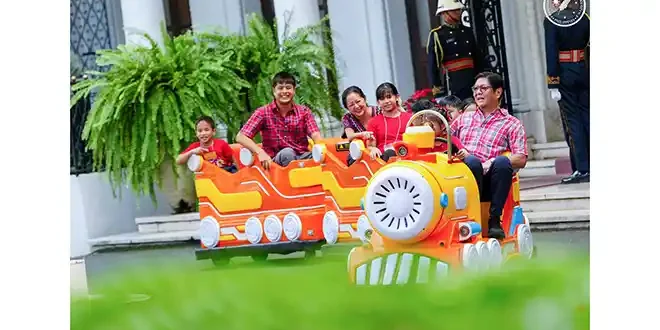
There are few images more striking in Philippine politics than that of the President of the Republic rolling into Malacañang aboard a kiddie train. Yet on Saturday, that was precisely how President Ferdinand Marcos Jr., joined by First Lady Liza Araneta-Marcos and their youngest son Vinny, chose to open the annual Balik Sigla, Bigay Saya gift-giving program—a tradition that has evolved into a nationwide event spanning several Christmas seasons. It was an intentionally playful gesture, one designed to underscore the event’s message: that children are the heart of the Christmas spirit.
Some 2,712 children from local government units across the country gathered at the Kalayaan Grounds for this year’s celebration. For many of them, the experience was not only a rare visit to the Palace but also a moment of being openly recognized in a system that often overlooks the youngest in society. In his remarks, the President went beyond the usual holiday greetings to share an observation that felt unusually candid: that in Malacañang, smiles are often scarce.
He joked that on ordinary days the palace corridors are filled with serious faces—workers burdened with instructions, officials preoccupied with state matters. But on this day, he said, the children changed everything. “Ngayon lang, pag nandito kayong mga bata… lahat nakangiti,” he said. It was, in essence, an acknowledgment that governance is heavy work, and that the refreshing presence of children can momentarily soften even the most hardened corners of power.
This message resonates because in a year marked by rising food prices, persistent inequality, and troubling global uncertainties, joy has become a scarce resource. And yet, the President was not wrong to say that children remain “the biggest blessing and treasure” of the nation. For all the country’s hardships, the Philippines remains a remarkably young nation—with nearly a third of its population below 15 years old. These are the individuals who will inherit the consequences of today’s decisions, good or bad.
But while celebrating children is admirable, valuing them requires more than smiles at Christmastime. It demands sustained investment in nutrition, education, healthcare, and family welfare—sectors that continue to struggle despite successive administrations’ promises. The President’s gesture, therefore, must be measured not merely by its sentiment but by the policies that will follow.
To his credit, Marcos Jr. emphasized that the Christmas season should remind Filipinos of their blessings, even as the country confronts “mabigat na mga hamon.” It was a subtle recognition that the nation is far from where it needs to be, and that joy cannot mask structural challenges. Still, his words serve as a gentle reminder that even small respites matter—that communities, governments, and families need moments that anchor them back to hope.
Beyond the children’s festivities, the administration has highlighted its expanded assistance programs for vulnerable Filipino families, including indigenous peoples and farmers. The collaboration with the Leave Nobody Hungry Foundation Inc. to deliver livelihood support and welfare projects is a step toward addressing systemic poverty. These efforts, if implemented effectively and transparently, could go far in uplifting communities that have long been left behind.
Yet this is where the challenge truly lies. Gift-giving is easy; nation-building is not. For every food pack or toy distributed at Malacañang, millions more children across the country continue to face hunger, malnutrition, and barriers to schooling. If the government aspires to make children the “biggest treasure,” then long-term policies must reflect that value—not just in December, but throughout the year.
What does it mean for the country when Malacañang opens its doors to children? In one sense, it humanizes the presidency, reminding citizens that leadership does not have to be cold or distant. It signals a desire to project empathy at a time when many Filipinos feel unseen. Whether this is an earnest tradition or political theater is something each citizen will judge differently.
If the smiles of 2,712 children were enough to light up the Palace, then perhaps—just perhaps—they can also nudge the country to remember what truly matters.
For in those small, fleeting moments of joy, we are reminded that the future is watching us. And the real test lies not in how brightly the Palace glows during Christmas, but in how steadfastly the country commits to giving its children a future worthy of their laughter.