 The Market Monitor Minding the Nation's Business

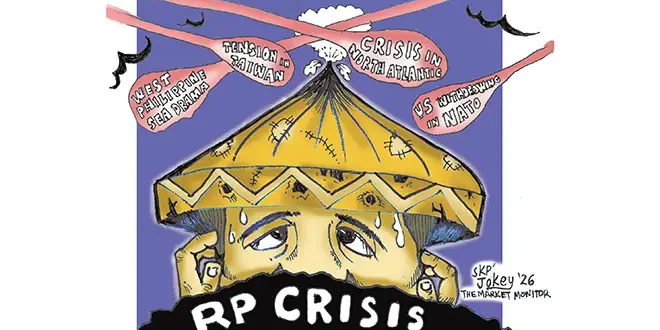
While impeachment complaints against President Ferdinand Marcos Jr. and Vice President Sara Duterte dominate headlines and political chatter, Filipinos risk missing a far larger and more consequential development beyond our shores. In an era of sharpening great-power rivalry, global flashpoints—real or emerging—have a way of reshaping priorities overnight. If the world’s attention is drawn to a crisis in the North Atlantic, the repercussions will not stop at Europe’s borders.
Recent rhetoric surrounding Greenland, a strategically vital Arctic territory under Denmark, has alarmed European and NATO leaders. The Arctic is no longer a frozen backwater; it is a corridor of shipping routes, energy reserves and military positioning. Any suggestion that a major power would seek to forcibly alter the status quo there, especially while threatening punitive tariffs against dissenters, underscores how fragile the current international order has become. For Europe, such talk revives old fears of abandonment and coercion. For NATO, it raises uncomfortable questions about unity and credibility.
The crisis presents a distinct possibility of the US withdrawing from NATO, drastically reshaping the global order.
For the Philippines, the danger lies less in Greenland itself than in what a transatlantic crisis would do to American attention and resources. The United States remains the central external balancer in the Indo-Pacific. A serious confrontation in Europe—particularly one involving multiple NATO allies—would inevitably stretch Washington’s diplomatic bandwidth, military assets and political focus. History shows that when great powers are distracted in one theater, rivals probe elsewhere.
This matters profoundly in our region. Tensions in the Taiwan Strait remain high, and any escalation there would almost certainly spill into the broader Western Pacific, affecting Philippine security, trade routes and alliance obligations. Even without a dramatic trigger, pressure in the West Philippine Sea continues through gray-zone tactics, maritime patrols and information operations. None of these require a formal declaration of war to undermine sovereignty or test resolve.
The Philippines should not rely on the United Nations to intercede as any united resolution drag over time.
It is precisely because threats today are often incremental and deniable that complacency is dangerous. National security is not only about ships and missiles; it is also about internal cohesion, institutional resilience and strategic focus. Excessive fixation on short-term electoral maneuvering risks weakening the very unity needed to navigate an uncertain international environment. Democracies can and should hold leaders accountable, but timing and proportion matter. A nation consumed by internal power struggles is less able to respond to external shocks.
This does not mean Filipinos should surrender critical thinking or political participation. Rather, it calls for a broader horizon. Citizens, media and policymakers alike must track global developments that could reshape alliance dynamics and regional stability. Contingency planning, defense modernization, and diplomatic engagement with partners should not pause simply because domestic politics are noisy.
The world is entering a period where crises may erupt far from our immediate neighborhood yet still alter our security calculus. Whether in the Arctic, Eastern Europe or the Indo-Pacific, the actions of great powers are increasingly interconnected. Filipinos would do well to look up from today’s political skirmishes and ask a harder question: are we prepared for the consequences of a world where multiple flashpoints ignite at once?