 The Market Monitor Minding the Nation's Business

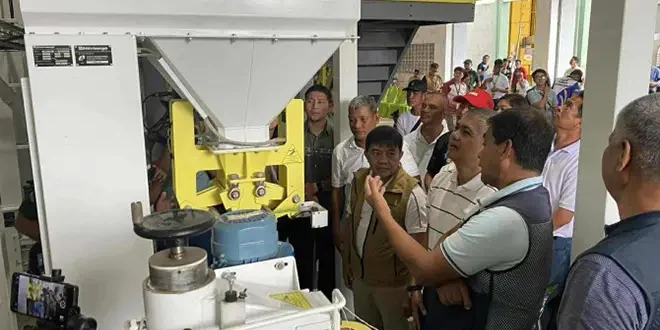
Lawmakers from Abra are urging Congress to swiftly pass a bill that would accelerate the establishment of agro-processing facilities in every province, aimed at strengthening food security and protecting farmers from mounting climate risks.
Solid North Party-list Rep. Ching Bernos and Abra lone district Rep. JB Bernos filed House Bill No. 6514, also known as the AgriBoost bill, which proposes a fast-tracked system for building provincial agro-processing centers (PAPCs) for key commodities such as rice, corn, coffee, and root crops.
“The climate crisis is forcing governments around the world to adapt. As weather phenomena become greater in intensity, we must take the steps to ensure that our produce are not always at the mercy of the elements,” Ching Bernos said in a statement released Thursday.
She noted that inadequate storage and processing facilities have made crop spoilage a recurring problem for Filipino farmers—an issue the proposed measure seeks to address.
Under the bill, an Accelerated Provincial Agro-Processing Centers Program will be created to oversee the construction, upgrading, or certification of at least one PAPC in every province within five years from the law’s enactment.
The program will take inspiration from the Classroom-Building Accelerated Program and will allow local government units to partner with the private sector through joint ventures, build-operate-transfer schemes, leasing, or management contracts to speed up facility development and operations.
Rep. JB Bernos said farmers themselves will have a direct voice in managing the centers, with two farmer representatives mandated to sit on each PAPC board.
The board will also include the provincial agriculturist as chair, a regional representative from the Department of Agriculture, and a private sector representative.
“This measure would also help reduce farmer dependence on traders and middlemen, increase rural employment through agro-industrialization, and ensure that the benefits of agricultural growth reach the producers themselves,” he said.
“Dagdag pa rito, maiiwasan din ang mataas na gastos sa transportasyon, handling, at storage ng ating mga ani. Maaari rin nating i-target ang exportasyon ng ating mga produkto (In addition, the high cost of transportation, handling and storage will be avoided. The export of farmers’ produce can now be targeted),” Bernos added.