 The Market Monitor Minding the Nation's Business
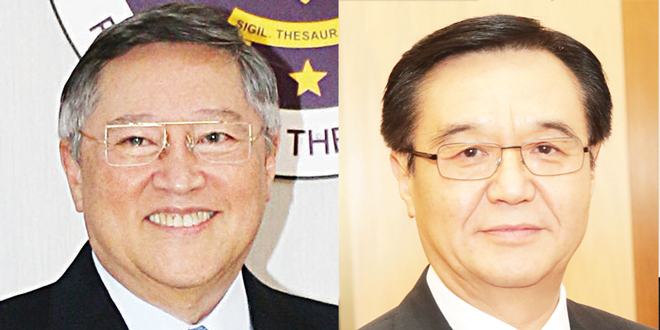
Beijing has agreed to study Manila’s proposal to implement through hybrid or co-financing arrangements with multilateral institutions the big-ticket Philippine projects that had been submitted to China for possible funding by the Duterte administration.
Finance Secretary Carlos Dominguez III, who led a top-level government delegation to Beijing last week, said China Commerce Minister Gao Hucheng had welcomed his proposal to consider co-financing the projects with other multilateral lending institutions such as the Asian Development Bank (ADB), the World Bank, and the China-led Asian Infrastructure Investment Bank (AIIB).
He said Gao had informed the Philippine delegation in their talks during the Jan. 23-24 mission that Beijing would want “to clarify the operating procedures” in executing such arrangements and determine if this would lead to a more efficient and smooth implementation of the project.
According to Dominguez, ranking Chinese officials have agreed with the delegation on the urgency of implementing projects that Manila has proposed to China for possible financing under the Duterte presidency.
They also agreed on the importance of “openness and transparency” in the ongoing talks on the MOUs that were sealed last year during PRRD’s China visit as well as in the implementation stage of the projects that China would eventually underwrite.
The Philippine delegation submitted a total of 40 “large and small” infrastructure projects to China for possible loan financing and assistance in conducting feasibility studies during the Jan. 23-24 mission.
Of the 40 projects, 15 are being proposed for loan financing while another 25 were submitted for feasibility study support.
Three of these large-scale projects are worth $3.4 billion combined.
These are the Chico River Pump Irrigation Project in the provinces of Cagayan and Kalinga with an estimated total project cost of $53.6 million; the New Centennial Water Source-Kaliwa Dam Project in Quezon, $374.03 million; and the South Line of the North-South Railway running from Manila to Legaspi City in Bicol, $3.01 billion.
Nine other projects, which aim to interconnect the country’s three main island-groups, boost tourism, and construct a flood control system in Mindanao and ensure its stable power supply, were presented by the Philippine team to Gao for feasibility study support.
Dominguez said the other projects on the list are relatively small in scale, and are easier to implement, such as the construction of bridges across the Pasig River to ease traffic congestion in Metro Manila.
He said that during the Philippine delegation’s meeting with China’s Commerce Ministry officials led by Gao, both parties agreed to regularly hold bilateral meetings to ensure that the projects approved for Chinese financing “are aligned with the priorities of both countries.”
Trade Secretary Ramon Lopez said last year that President Duterte’s state visit yielded $24 billion-worth of aid and investment pledges from China comprising soft loans totaling $9 billion and other economic deals amounting to about $15 billion.
Earlier, Dominguez said the Duterte administration is exploring hybrid financing arrangements that will combine development aid and loans in raising more funds for its big-ticket infrastructure projects while keeping down borrowing costs.