 The Market Monitor Minding the Nation's Business
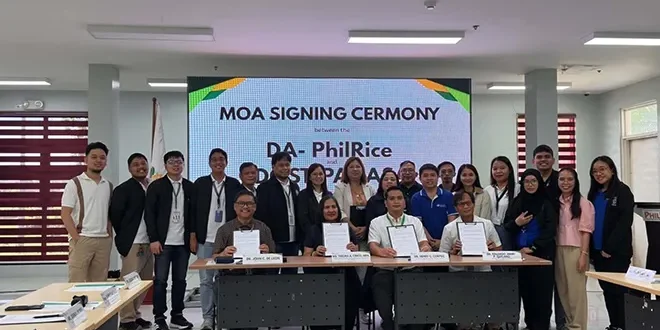
Weather and agricultural data will be combined under a new government partnership aimed at helping Filipino rice farmers better prepare for typhoons, droughts and other climate threats that can damage harvests.
The Philippine Atmospheric, Geophysical and Astronomical Services Administration (PAGASA) and the Philippine Rice Research Institute (PhilRice) have signed a data-sharing agreement that will provide farmers and government planners with a more complete picture of weather and climate risks affecting rice production.
PAGASA Administrator Dr. Nathaniel T. Servando, Weather Services Chief Thelma A. Cinco and Department of Agriculture-PhilRice Executive Director Dr. John C. De Leon signed the memorandum of agreement establishing the framework for exchanging weather, climate and agricultural information.
Agriculture Secretary Francisco P. Tiu Laurel Jr. said the partnership supports the government’s effort to modernize agriculture through data-driven decisions while strengthening food security.
“The PhilRice-PAGASA collaboration is an important step in our push for a more modern, climate-resilient, productive, and sustainable agriculture sector, while strengthening the country’s food security,” Tiu Laurel said.
“By bringing weather and climate information together with agricultural data, we can help government and farmers make better-informed decisions and respond more effectively to climate risks,” he added.
Under the agreement, PAGASA will provide PhilRice with weather and climate information, including rainfall, temperature, wind, cloud cover and humidity data through its ClimGridPh system and Ten-Day Weather Forecast API.
The weather agency will also share information on tropical cyclone tracks, rainfall advisories, drought and dry-spell assessments, soil moisture, rainfall forecasts and surface-temperature forecasts.
PhilRice, meanwhile, will provide PAGASA with rice-area and planting-date maps from the Philippine Rice Information System or PRiSM, along with rice growth-phase data, risk assessments, historical provincial production and yield figures, and rice variety information when applicable.
The agencies expect the combined datasets to support earlier and more targeted advisories and interventions when extreme weather threatens rice production.
The partnership will also help planners better identify areas and stages of rice production that may be most vulnerable to typhoons, drought and other weather disturbances.
The agreement includes safeguards covering data security and intellectual property. Shared information will be used for research and development, while raw API data, system credentials and proprietary datasets cannot be released to third parties without prior written consent from the institution that provided them.
The agreement took effect upon signing and will remain in force until December 2028, unless renewed, amended or terminated under its provisions.