 The Market Monitor Minding the Nation's Business
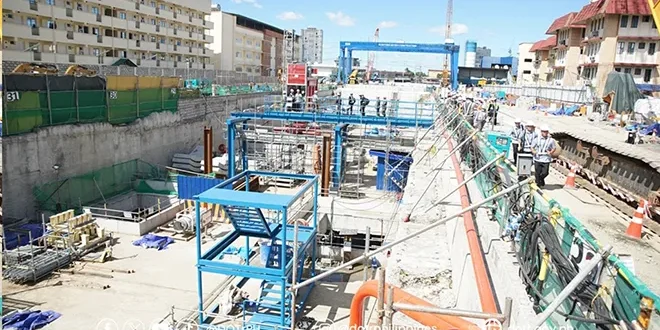
Government need to catch up in securing the right-of-way (ROW) for big-ticket railways, with nearly 49,000 informal settler families (ISFs) still waiting to be relocated.
As of November 2024, the Department of Transportation (DOTr) resettled only 1,756 of the 50,633 ISFs that live within the alignment of priority railways, based on a report submitted to the House of Representatives.
These projects include the P873.6-billion North-South Commuter Railway, P488.5-billion Metro Manila Subway Project (MMSP), P175.32-billion South Long Haul Project, P68.2-billion Metro Rail Transit Line 7 and the P64.9-billion Light Rail Transit Line 1 Cavite Extension Project.
The MMSP, in particular, is facing the toughest challenge in ROW procurement, as shown in DOTr’s pace in disbursing funds for the project. DOTr managed to disburse 98% of its ROW budget for the subway in 2019, 96% in 2020 and 98.4% in 2021.
However, disbursement fell to 51.6% in 2022, upon the entry of the Marcos administration, and crashed to one percent in 2023. The MMSP requires DOTr to do subterranean works.
Under Republic Act 10752 or the ROW Act, real estate owners have the right to their land up to 50 meters below ground level. The MMSP goes as low as 20 meters beneath the surface.
In response, President Marcos last year formed an interagency task force, chaired by DOTr, for the crafting of policies to expedite ROW acquisition.
Further, the government is banking on the Real Property Valuation and Assessment Reform Act, which was enacted into law in 2024, to improve the valuation process and help in getting ROW.
However, the Congressional Policy and Budget Research Department (CPBRD) said the most critical reform to enhancing ROW efforts would be amending the ROW Act. Primarily, the CPBRD said the underground ROW has to be reduced to 15 meters.
This way, the DOTr can pursue more subway projects in the future given the limited space it can work on above ground. The CPBRD said it is a safety risk if subways go deeper than 50 meters, and this is why underground projects abroad are as shallow as six meters like in Finland.
Recently, the DOTr was hit with a legal opinion favoring the ROW Act over financing contracts with multilaterals, which are funding big-ticket projects like the MMSP.