 The Market Monitor Minding the Nation's Business
By Rose dela Cruz
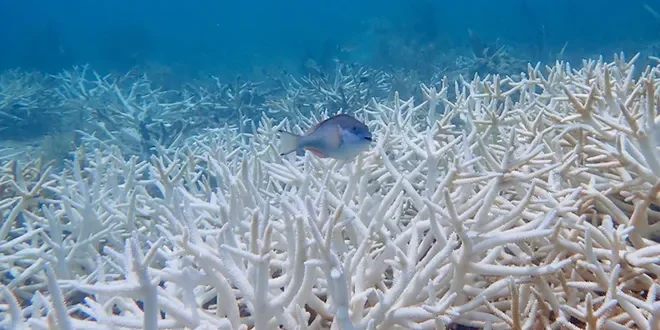
In the next 50 years, nearly all coral reefs in the world– sometimes considered the ‘rainforests of the sea’– would collapse because of coral bleaching from warming oceans, heat waves, and other factors.
A story published by the Associated Press cited a recent global assessment showing that these critical sources of seafood and tourism, which often buffer coastal erosion and storms, are in an increasingly perilous state.
Sometimes dubbed “rainforests of the sea,” the reefs have some of the world’s richest biodiversity and support a quarter of marine species as well as coastal communities and businesses.
The International Union for Conservation of Nature announced on the sidelines of a U.N. biodiversity conference in Albania that some 96% of shallow-water reef systems are already critically endangered and could disappear by 2075, the AP noted.
Most of the world’s famous reef systems — including the Great Barrier Reef in Australia, the Coral Triangle in the Western Pacific Ocean and Southeast Asia, the Mesoamerican Barrier Reef System and the Red Sea coral reefs — are all critically endangered, the highest level of threat.
“The risk of coral reef collapse is escalating, but this must be a wake-up call rather than a cause for despair,” said Mishal Gudka, the scientific lead of the global IUCN Red List of Coral Reef Ecosystems assessment, the first of its kind.
“Coral reefs have shown a remarkable ability to bounce back from devastating bleaching events,” he said, adding that “pockets of surviving, resilient coral reefs can still remain in the future, so we must do everything within our reach to set them up for success.”
When a reef collapses, hard corals disappear and are replaced by algae, rubble and sponges. As a result, the reef no longer supports a diverse ecosystem that can include everything from tiny invertebrates to reef fish like grouper.
“Coral reefs are one of the clearest vital signs of the ocean’s health,” Grethel Aguilar, the IUCN director-general, said in a statement.
The assessment, spanning 127 tropical and subtropical ecoregions and encompassing 72,726 square miles (188,362 square kilometers) of coral reefs globally, called climate change the “single most consistent threat driving coral reef decline worldwide.”
A week ago, another study in the journal Nature by the IUCN found that nearly 44% of reef-building coral species face an elevated risk of extinction due to climate change. A year ago, a survey found that harmful bleaching of the world’s coral has grown to include 84% of the ocean’s reefs — the most intense of its kind in recorded history.
The year 2024 was Earth’s hottest on record, and much of that is going into oceans. The average annual sea surface temperature of oceans away from the poles was a record 69.57 degrees Fahrenheit (20.87 degrees Celsius).
Beyond combating rising global emissions, experts said efforts to reduce pollution, overfishing and coastal development can help reefs survive.
“We know what is needed: ambitious emissions reductions, stronger protection and restoration efforts, and sustained investment in resilient coastal ecosystems and the communities that depend on them,” Aguilar was quoted by the AP.
Andrew Baker, director of the Coral Reef Futures Lab at the University of Miami, sought to inject some hope after reviewing the assessment. He said stopping global warming and pollution isn’t the only way to save corals.
“It means finding new ways to restore corals using emerging technology and innovative approaches,” he said, “that can throw a lifeline to struggling reefs and buy us critically needed time to make these transitions.”