 The Market Monitor Minding the Nation's Business
By Luis Leoncio
The government will provide P200 a month “without conditions” this year to 10 million of the country’s poorest households over the next three years as a buffer to the backlash on prices of basic commodities of the implementation of the Tax Reform for Acceleration and Inclusion (TRAIN), economic managers said.
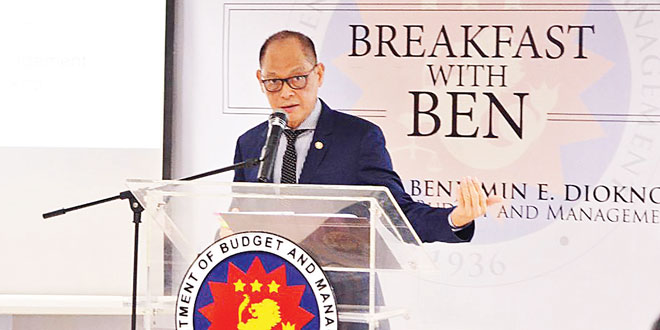
Budget Secretary Benjamin Diokno in 2019 and 2020 the subsidy will be raised to P300 per month per household.
Diokno said the recently-approved national budget for this year or the 2018 General Appropriations Act (GAA) has provisions that seeks to offset the slight increase in prices due to the (TRAIN) law through social subsidies.
Finance Secretary Carlos Dominguez III said the subsidies to the poorest households is equivalent to almost P10,000 spread over the next three years, starting 2018 in unconditional cash transfers (UCTs).
In the 2018 budget, a total of P28.8 billion has been earmarked for the UCTs, loan facility subsidies for the Public Utility Vehicle (PUV) Modernization Program, and the implementation of the National ID System.
“We laud the passage of Package 1A of TRAIN insofar as it supports the administration’s socio-economic agenda,” Diokno said.
“It will raise the necessary revenues for our much-needed Build Build Build program and social services initiatives,” he added.
“Nevertheless, we are aware of the short-term and transitory effects of TRAIN on consumer prices, which is why the government incorporated these mitigating measures in the 2018 Budget,” he added.
In particular, P24.5 billion has been set aside for unconditional cash grants to the poorest 50 percent of households identified by the Department of Social Welfare and Development (DSWD) through the National Household Targeting System for Poverty Reduction (NHTS-PR).
The said allocation is included in the budget of the Land Bank of the Philippines (LBP). For 2018, over 10 million Filipino households will receive P200 a month to offset the slight increase in prices due to the higher excise taxes imposed by TRAIN.
“The unconditional cash grants will more than offset the short-term inflationary impact of TRAIN,” Diokno added.
“This is in response to critics who say that TRAIN is anti-poor because the informal sector and already tax-exempt wage earners will be faced with higher excise taxes,” he said.
“So aside from increasing the take-home pay of many workers with the reduced income tax rates, we will also augment the incomes of the poorest fifty percent of households,” Diokno said.
Even as TRAIN is seen to boost inflation by 0.85 to 1.2 percentage points in 2018 and by 0.4 to 0.55 percentage points by 2019, this is projected to be countered by the lowering of rice prices through rice policy reforms.
The proposed removal of quantitative restrictions on rice could lower inflation by about 1.14 percentage points annually, he said.
“The inflationary effects of TRAIN are projected to be temporary, aside from being countered by lower rice prices with the removal of quantitative restrictions,” Diokno said.
“This is why the BSP maintained its inflation target at 2 to 4 percent, and approved by the DBCC last December 2017,” he said.
“In the long-term, TRAIN should even lead to lower prices as it will result to better productivity and lower transportation costs with superior infrastructure,” he noted.
Meanwhile, about P2.3 billion is allocated for the loan facility to be extended to public utility vehicle (PUV) drivers to replace old jeepneys with safer, more comfortable, and more economic PUVs.
The use of the said funds, lodged in the budgets of the LBP and the Development Bank of the Philippines (DBP), respectively, will be subject to guidelines set by the Department of Transportation (DOTr).
Some P2.0 billion is also earmarked for the implementation of the National ID System. The allocation was placed under the budget of the Philippine Statistics Authority (PSA) and will ensure that public resources are delivered to their intended beneficiaries.
The National ID system will limit leakages in the delivery of social services programs, particularly the cash transfer programs of the government.
Dominguez said among the TRAIN’s key provisions is the earmarking of up to 30 percent of the incremental revenues to be raised from this law for social services, which include UCTs of P200 a month (or P2,400 per year) for the country’s 10 million poorest households for 2018, which will increase to P300 a month (or P3,600 per year) in 2019 and 2020, or a total of P9,600 in cash subsidies for each household over this three-year period.
He said that besides providing cash transfers for the poor, the government’s “Build, Build, Build” infra program will also create more livelihood and employment opportunities for them.
Besides cash transfers and job opportunities, Dominguez had earlier pointed out that even non-taxpayers will benefit from the TRAIN in terms of better infrastructure that will lower the transport and distribution costs of goods, and improved services.
He said those not paying taxes will also benefit because of higher spending for education, health care, and other forms of human capital development that would help set the foundation to lift themselves out of the poverty trap.
The TRAIN, which took effect last Jan. 1, will exempt compensation earners and self-employed individuals with an annual taxable income of P250,000 and below or those earning at least P21,000 a month from paying the personal income tax. The 13th month pay and other bonuses amounting to P90,000 are also tax-exempt.
For those earning P250,000 and above, the tax brackets have also been adjusted so that those with taxable incomes of more than P250,00 each but not above P2 million will pay only between 20 and 30 percent personal income tax (PIT).
Those earning P2 million annually but not above P8 million are taxed 32 percent. The hefty tax of 35 percent are reserved for those earning P8 million and above.
Starting 2023, the brackets will be adjusted further so that those with taxable income of more than P250,00 but not above P2 million are taxed between 15 percent and 25 percent. Those earning P2 million annually but not above P5 million will be taxed 30 percent by 2023, while those above P8 million will be paying 35 percent personal income tax.
The TRAIN will offset the revenue-eroding PIT cuts with revenue-enhancing measures such as broadening the value-added tax (VAT) base; adjusting excise taxes on fuels, automobiles, and alcohol and tobacco products; and introducing a tax on sugar-sweetened beverages (SSBs) with exemptions.
Dominguez has pointed out that one major benefit of the infrastructure buildup is the distribution of wealth to the countryside as farmers and other rural workers would eventually be able to transport their goods at lower costs and widen their access to markets.
People in urban centers, in turn, will get to enjoy lower prices of basic goods because of the reduced costs of transporting and distributing them, he added.
He has also allayed concerns that the adjustments in fuel excise taxes would lead to a ripple effect of higher inflation and higher prices of consumer goods, as the Philippine economy has become more diversified over the years as a result of the sound fiscal management policies of the previous administrations.
Dominguez said when diesel prices spiked by 75 percent in 2016, inflation remained low and stable at 2.7 percent. Hence, the prices of food, transportation, electricity, gas, housing and water did not increase significantly.