 The Market Monitor Minding the Nation's Business

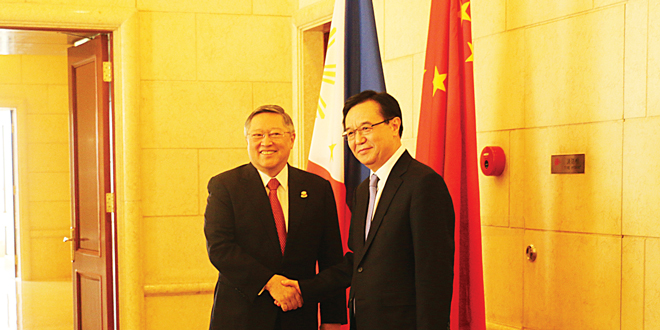
The Duterte administration has made headway into tapping China for its massive infrastructure buildup plan. During a recent economic mission to China, a high-level delegation led by Finance Secretary Carlos Dominguez III presented three large-scale infrastructure projects to Beijing for possible loan financing, while nine others were submitted for feasibility study support.
Dominguez said the three projects that would undergo China’s loan-application process have already been approved by the board of the National Economic and Development Authority (Neda) and the Investment Coordination Committee (ICC).
Dominguez and members of the mission presented to China Commerce Minister Gao Hucheng the three projects which has a combined total cost of $3.4 billion (P170 billion) during the two-day visit that ended last Jan. 24.
The projects which are being considered by China are the Chico River Pump Irrigation Project in the provinces of Cagayan and Kalinga, with an estimated total project cost of $53.6 million (P2.68 billion); the New Centennial Water Source-Kaliwa Dam Project in Quezon, $374.03 million P18.7 billion); and the South Line of the North-South Railway Project (NSRP) running from Manila to Legazpi City in Bicol, $3.01 billion (P150.5 billion).
Dominguez said the three priority projects would seek loan financing under the $3.4-billion assistance made available by the Export-Import Bank of China (China Exim) to the Philippines, of which $2 billion is new commitment.
These projects aim to raise the productivity of small farmers, improve transportation and logistics services in underserved areas of Luzon, and ensure a steady water supply to Metro Manila, he said.
“We are looking at implementing large infra projects in the rural areas, particularly in irrigation, logistics in bridges and roads to connect communities to the major markets,” Dominguez said.
Nine other projects that aim to interconnect the country’s three main island-groups, boost tourism, and construct a flood-control system in Mindanao and ensure its stable power supply, were likewise presented by the Philippine team to Gao for feasibility study support.
Up for the Chinese government’s review are the North Luzon Expressway East Project, the Panay Guimaras-Negros Island Bridges, the Davao City Expressway, the Ambal-Simuay Sub-Basin of the Mindanao River Basin Flood Control and River Protection Project, the Dinagat (Leyte)-Surigao Link Bridge, the Luzon-Samar Link Bridge, the Agus 3 Hydroelectric Plant, the Pasacao-Balatan Tourism Coastal Development Program, and the Camarines Sur Expressway, with a total indicative cost of $1 billion (P50 billion).
Dominguez said the government has submitted the relevant documents and materials to Chinese officials to speed up the assessment process for these nine projects.
The 12 projects are part of the 40 “large and small” infra projects presented by the Philippines to China during the ay mission.
Dominguez said the meeting of the Philippine team with officials of China’s Ministry of Commerce was a “productive first step toward achieving the desire of (President Duterte and Chinese President Xi Jinping)” in further reinforcing ties between the two countries.”
Aside from Dominguez, the Philippine delegation included Secretaries Benjamin Diokno of the Department of Budget and Management (DBM), Arthur Tugade of the Department of Transportation (DOTr) and Mark Villar of the Department of Public Works and Highways (DPWH); and Director-General Ernesto Pernia of the National Economic and Development Authority (Neda).
Neda Deputy Director-General Rolando Tungpalan, DPWH Undersecretaries Emil Sadain and Karen Jimeno, and Bases Conversion and Development Authority (BCDA) President-CEO Vivencio Dizon were also part of the delegation.
Joining them were DOF Assistant Secretaries Ma. Edita Tan and Mark Dennis Joven, DOTr Assistant Secretaries Leah Merida Quiambao and Cesar Chavez, and Assistant Secretary Julia Nebrija of the Metro Manila Development Authority.
Dominguez said the generous assistance offered by China to the Philippines during the mission was among the concrete results of Mr. Duterte’s foreign-policy rebalancing toward accelerated integration with the Asean (Association of Southeast Asian Nations) and its major Asian trading partners China, Japan and South Korea.
He said that amid global uncertainty over a possible overhaul of US trade policies under the new presidency of Donald Trump, it was a “very smart” move by Mr. Duterte to recalibrate the Philippines’s foreign policy early on and reorient the economy toward greater integration with its Asian neighbors.
“It makes good sense to be closer with our neighboring countries than with our distant friends,” he said.
In the meeting with Gao, Dominguez informed Chinese officials about the Duterte administration’s three priority objectives, which are to reduce poverty, develop a law-abiding citizenry, and establish a society whose citizens are at peace among themselves and with their neighbors in the international community.
Dominguez said the 40 projects discussed during the meeting aim to help realize the President’s primary goal of reducing poverty.
Dominguez said the other projects on the list are relatively small in scale, and are easier to implement. LUIS LEONCIO