 The Market Monitor Minding the Nation's Business

The Philippines retained its score of 35 out of a perfect 100, indicating a corruption-free public sector, in the annual Corruption Perceptions Index (CPI) of Transparency International (TI), even as the country slid in the annual ranking as it placed 101st out of 176 countries this year. compared to its 95th place out of 168 countries last year.
The country was ranked along with Gabon, Niger, Peru, Thailand, Timor Leste, and Trinidad and Tobago with a grade of 35.
Commenting of the Philippines’ situation, TI said President Duterte’s dramatic rise to power “made extensive use of anti-corruption rhetoric. Yet, the impact of death squads, attacks on the media and violent intimidation to the detriment of democracy and democratic institutions is yet to be seen in 2017.”
The Berlin-based TI said in its statement that “deep-rooted” reforms were needed worldwide to tackle the inequality and systemic corruption that have proved such “fertile ground” for populists.
The TI said the rise of populist politicians around the world risks undermining the fight against corruption, warning that it feared a backslide in the US under new President Donald Trump.
“Populism is the wrong medicine,” TI said.
For its 2016 index, the watchdog ranked 176 countries on a scale of 0-100, where zero means very corrupt and 100 signifies very clean.
The data is based on surveys from the World Bank, the African Development Bank, the Economist Intelligence unit and other bodies.
New Zealand and Denmark shared the No.1 spot with a score of 90 points, with Finland, Sweden, Switzerland and Norway rounding out the top five of squeaky-clean nations. Strife-torn Somalia was the worst offender on the list for a 10th year running, followed by South Sudan, North Korea and Syria.
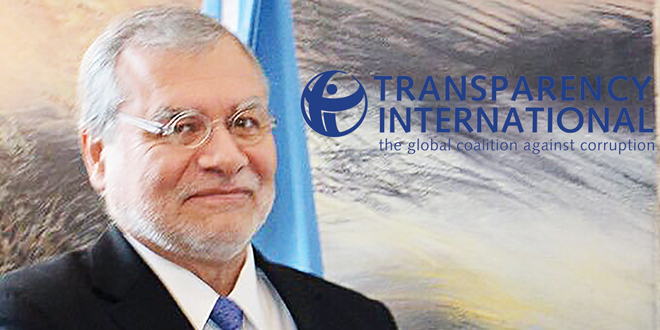
“In countries with populist or autocratic leaders, we often see democracies in decline and a disturbing pattern of attempts to crack down on civil society, limit press freedom, and weaken the independence of the judiciary,” TI Chairman Jose Ugaz said.
“Instead of tackling crony capitalism, those leaders usually install even worse forms of corrupt systems,” he said in a statement.
The watchdog said that both Hungary and Turkey, “countries that have seen the rise of autocratic leaders,” have slipped in the corruption rankings in recent years.
Concerns are also mounting about the United States, where Trump assumed power last week following a campaign that railed against the political “elite” and promised to clean up corruption in Washington.
Finn Heinrich, a research director at TI, however, said he was “not hopeful” the US billionaire would live up to those pledges, given his myriad business conflicts, his attacks on the media and his refusal to release his tax returns.
“When you see that Donald Trump has put his son-in-law as a senior advisor that smells off,” he said.
“His whole Cabinet is full of conflicts of interest. He said he would drain the swamp. The first signs show that he would rather water it,” Heinrich said.
The United States fell two places to reach the 18th spot in TI’s latest index with a score of 74 out of 100, down from 76 in 2015.
“If (Trump) keeps his promises to fight corruption, I think the US can improve. But if you look at his actions so far, what we worry about is that there will be a decline,” Heinrich said.
2016 showed that around the world, systemic corruption and social inequality reinforce each other, leading to popular disenchantment with political establishments and providing a fertile ground for the rise of populist politicians.
The TI noted that 69 percent of the 176 countries in the Corruption Perceptions Index 2016 scored below 50, on a scale from 0 (perceived to be highly corrupt) to 100 (perceived to be very clean), exposing how massive and pervasive public-sector corruption is around the world.
TI said more countries declined in the index than improved this year. It noted that “corruption and inequality feed off each other, creating a vicious circle between corruption, unequal distribution of power in society, and unequal distribution of wealth.”
“In too many countries, people are deprived of their most basic needs and go to bed hungry every night because of corruption, while the powerful and corrupt enjoy lavish lifestyles with impunity,” Ugaz added.
People are fed up by too many politicians’ empty assurances to tackle corruption and many are turning toward populist politicians who promise to change the system and break the cycle of corruption and privilege, it said.
“Only where there is freedom of expression, transparency in all political processes and strong democratic institutions, can civil society and the media hold those in power to account and corruption be fought successfully,” it added.
The index scores of Hungary and Turkey, countries that have seen the rise of autocratic leaders, have dropped in recent years. In contrast, the score of Argentina, which has ousted a populist government, is starting to improve.
Technical fixes to specific anti-corruption legislation are not enough. What is urgently needed are deep-rooted systemic reforms that even up the growing imbalance of power and wealth by empowering citizens to stop the widespread impunity for corruption, hold the powerful to account, and have a real say in the decisions that affect their daily lives, it added.
These reforms must include the disclosure through public registries of who owns companies as well as sanctions for professional enablers who are complicit in moving corrupt money flows across borders, it said. LUIS LEONCIO