 The Market Monitor Minding the Nation's Business

By Luis Leoncio
The Philippines had the most robust economy in Asia for 2016 when it posted a 6.8-percent full-year growth as gross domestic product (GDP) expansion moderated in the fourth quarter to 6.6 percent.
Full-year figures released thus far showed that the Philippines’ major growth competitors, China and Vietnam, fell short in matching the country’s figures, with economies of both countries growing at 6.7 percent for the entire year. Other major Asian economies have yet to release their GDP figures for the entire year.
“We are seeing a transformation to a stronger, more developed economy,” Frederic Neumann, co-head of Asian economic research at HSBC Holdings Plc in Hong Kong said. “Recent administrations worked hard to ensure macroeconomic stability which serves as its anchor,” he added.
Economic output is now worth about $292 billion, and by the end of this decade, the Philippines can achieve upper middle-income country status with a per-capita income of at least $4,126, the Asian Development Bank forecasts, joining the likes of China, Malaysia and Thailand.
The 6.6-percent GDP expansion during the period was the slowest for the year.
The agriculture sector was the dampener during the period; it contracted 1.1 percent in contrast to industry, which recorded the fastest growth in the period at 7.6 percent, higher than previous year’s 6.5 percent growth.
The services sector also decelerated by 7.4 percent, compared with the 7.8-percent growth in the fourth quarter of last year.
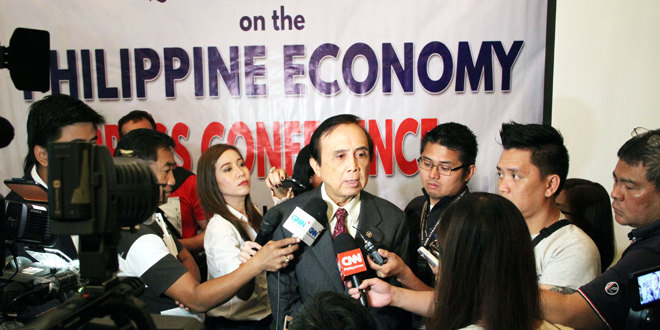
Socioeconomic Planning Secretary Ernesto Pernia said full-year growth of 6.8 percent was within the high-end of the government’s target of 6-percent to 7- percent growth rate for 2016.
This also brings the seven-year moving average of real GDP growth rate to 6.3 percent—the highest since 1978.
Growth in the last quarter of 2016 was backed by higher investment and consumption, which was a testament that the economy remains robust and is growing at a healthy and steady pace, Pernia added.
“Although this is lower than the 7-percent growth in the third quarter of 2016, this is higher than the 6.3-percent growth recorded during the fourth quarter of 2015,” he said.
He noted that the last quarter growth of an election year is usually slower than the first half due to the transition of government, and as investors adopt a “wait-and-see” attitude.
Net Primary Income (NPI), which included the contribution of remittances from the estimated 10 million overseas Filipino workers (OFWs) slowed down by 4.1 percent, compared with the 11.5-percent growth a year ago.
As a result, gross national income (GNI) posted a growth of 6.1 percent, slower than previous year’s growth of 7.3 percent.
On an annual basis, GNI accelerated by 6.6 percent, maintaining the NPI’s growth at 5.3 percent.
Domestic demand continued to fuel growth for the fourth quarter of 2016.
“There was continued robust expansion in investments, which grew by 15 percent. Public investment in infrastructure remained strong with public construction expanding by 23 percent, faster than the 20.1 percent growth in the third quarter,” Pernia said.
He added that private consumption grew, though slower than the previous quarter, to a still respectable 6.3 percent in the fourth quarter.
“This is attributed to high consumer confidence, modest inflation and interest rates, and improving labor market conditions,” he said.
Pernia projected the industry sector is seen to stay vibrant. “The construction industry, in particular, will be in the limelight following the government’s aggressive commitment to approve and implement critical infrastructure projects,” he said.
The services sector is also expected to remain strong, supported by moderate inflation, expected influx in inbound tourists, expansion in retail trade, a healthy financial system, sustained growth of remittance, and the continuing growth of the IT-BPM sector.
Domestic demand has so far remained buoyant and should continue to provide support to economic growth in the near to medium-term. Improved employment prospects and favorable income conditions will underpin the growth in household consumption.
“Overall, given this growth in 2016, we believe that the target of 6.5 percent to 7.5 percent for 2017 is highly likely,” Pernia said, adding
that in the medium-term, growth is expected to strengthen further toward 7 to 8 percent a year.
“This would mean that over the next six years, the economy will expand by about 50 percent in real terms, and per capita income will rise by over 40 percent. This should bring us to upper middle-income category standing by 2022. More importantly, we hope to reduce the poverty incidence to 14 percent by 2022, thereby lifting about 6 million Filipinos out of poverty,” he said.
Pernia said the biggest roadblock to the economy remains extreme weather disturbances like El Nino.
“The country remains vulnerable to very strong typhoons. There is a strong call to develop our agriculture sector and make it resilient to such shocks,” he said.
“We are deeply concerned about the contraction of the crops sector in the fourth quarter following a contraction the previous year. More disturbing is the performance of the fishery subsector that remained in negative territory for almost seven years now, except only in 2013,” he said.
He added reducing the cost of food, especially of rice, is important in reducing poverty.
“At the same time, we need to raise productivity in the agricultural sector by helping farmers transition to higher value crops and making technology easily accessible,” he said.
He added that other potential downside risks include possible policy shifts in the US, greater volatility in capital flows, and geopolitical risks.
“Thus, the government needs to remain vigilant and consider potential repercussions to the Philippines economy,” Pernia said.