 The Market Monitor Minding the Nation's Business

By Luis Leoncio
While economic managers said the economy has enough buffers to blunt the effect of the current crisis in Mindanao, the long-term effect would largely depend on how “things pan out.”
“We trust the President and his security officials to do what has to be done to restore peace and order and protect our fellow Filipinos in the South,” Socioeconomic Secretary Ernesto Pernia said.
Pernia also said economic growth cannot be sufficiently sustained nor be inclusive without peace.
“This is why achieving peace, security, and public order is considered a bedrock strategy under the Philippine Development Plan (PDP) 2017-2022,” he added.
Finance Secretary Carlos Dominguez said the economy has enough buffers to absorb the impact on business of the martial-law declaration of President Duterte covering Mindanao.
The country’s solid macroeconomic fundamentals buoyed the local bourse and the peso, despite President Duterte’s declaration of martial law in Mindanao, he said.
Pernia is hopeful that, with all the policies, programs, and projects, many of which are already underway, the economy will remain resilient and keep growing, temporary disruptions notwithstanding.
Regarding the effect on the quality of life in Mindanao, Pernia expressed hopes the crisis is resolved very soon, as threats to security derail progress.
“Having the watchful eye of government forces, especially in Mindanao, will ease tensions and allow communities to live normally,” Pernia said.
He added that, as security forces deal with the situation there, the government must continue to do what it has set out to do under the PDP, which is a holistic and comprehensive approach to bringing about inclusive development and higher quality of life for all Filipinos, wherever they are.
While Mindanao’s contribution to the country’s economy has remained relatively minor owing to past neglect, this major island region has huge potential and can be a major driver of growth in both agriculture and trade, and this is what needs to be tapped and unleashed.
“We are encouraged that agricultural production recovered in the first quarter of the year, growing by 4.9 percent, following several quarters of decline. This was driven by high production gains for sugarcane, banana, pineapple, tobacco, peanut, monggo, cassava, tomato, garlic, onion, eggplant, and rubber. Many of these high-value crops are located in Mindanao,” Pernia said.
He added that there is a lot planned and already underway, especially for lagging areas in the country.
The PDP covers a wide range of interventions that will provide more and better opportunities for people not only in Mindanao, but also in the rest of the country.
“Let’s hope that peace and order challenges are quickly resolved, so as not to derail the implementation of plans,” Pernia said.
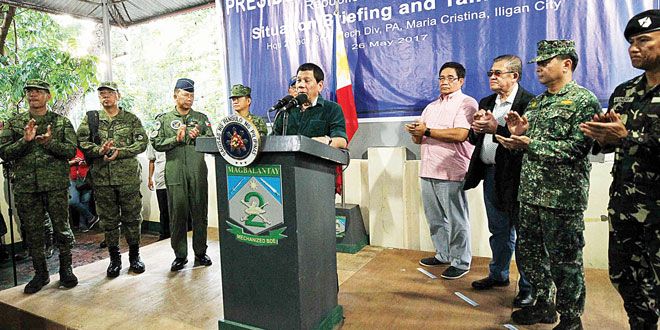
Mr. Duterte imposed martial law in Mindanao on May 23 to contain the threats of lawless elements in Marawi City, Lanao del Sur province.
Strong fundamentals
National Treasurer Rosalia de Leon said the Philippines’ ample buffers positioned the country to weather changes in global environment, noting that the nation’s external debt-to-gross domestic product (GDP) at 24.5 percent is one of the lowest in the region.
She added the country has a current account surplus since 2003, while its net foreign direct investments were at $7.933 billion in 2016, which is higher by 41 percent year-on-year.
The Philippines also has healthy level of international reserves at $81.8 billion, equivalent to nine months of import cover, she added.
De Leon said the government’s fiscal position remained strong and is well-managed, with only 2.3 percent deficit-to-GDP as end-March this year, while its debt-to-GDP ratio stood at 41.9 percent.
“The government’s average maturities is over 10 years and we have declining vulnerability to foreign-exchange shocks, with only 34.2 percent share of FX debt to total,” de Leon said.
“We continue to increase our reliance to peso funding taking advantage of ample liquidity,” she added.
Dominguez said the country’s growth momentum remains on track.
“The economy is in no way threatened by the imposition of martial law. The military is in full control of the government installations and major infrastructures on the island,” the Finance chief said.
“Martial law will ensure that these facilities are protected so that business transactions will be unaffected,” he added.
Dominguez pointed out that Mr. Duterte himself, upon his arrival from Russia, said at the airport that the government is prepared to do “anything and everything” to put an end to the lawless violence and restore normalcy in the affected areas as quickly as possible, so as not to affect the economy.
“The economy is rapidly growing; it is expected to grow by 6.5 percent to 7.5 percent during the year, with both internal and external demand contributing evenly to growth,” Dominguez said.
Although Marawi City is Lanao del Sur’s economic hub, he said “the threats by lawless elements are contained in areas far from Mindanao’s major business centers and the military is doing everything to minimize these.”
“Martial law in Mindanao for a limited period is intended to protect the flow of commerce, protect the innocent and eliminate future threats to the communities,” he added.
Mr. Duterte said the “compelling reason” for the declaration of martial law was the involvement of elements linked to the Islamic State (IS) group in the Marawi conflict, and that the whole of Mindanao was put under military rule to allow the government to best respond to the possibility of the terrorists seeking sanctuary or sowing terror in other parts of the South.
“The President is determined to protect the lives of innocent civilians and he will apply everything within his legal means to stop these extremist terrorist groups from further threatening the people of Mindanao and undermining government efforts to lift people up from poverty and transform the southern Philippines into a major growth center and investment destination,” Dominguez said.
China also expressed strong support to the government’s efforts to suppress terrorism by declaring martial law in southern island of Mindanao.
”Terrorism is the common enemy of mankind. China understands and firmly supports the Philippine government in cracking down on terrorism,” Chinese Foreign Ministry Spokesman Lu Kang said in a press conference on Wednesday.
”We believe under the leadership of Present Duterte, the Philippine government will surely safeguard security and stability in the Mindanao region,” Lu told the media.