 The Market Monitor Minding the Nation's Business
By DIEGO C. CAGAHASTIAN
TWO business-related developments coming from the United States government dominated the headlines in local media over the weekend—the first about the US Department of War’s plan to develop an oil storage facility in the Davao Region and second, the construction of a sprawling industrial hub in Central Luzon to secure Artificial Intelligence (AI) and semiconductor supply chains.
The US Defense Logistics Agency (DLA) issued a formal solicitation on March 31 for Washington-based contractors to build and operate a Defense Fuel Support Point (DFSP) along the coast of Mindanao. The facility will store nearly one million barrels of U.S. government-owned fuel to support warships and aircraft operating away from traditional northern hubs and is a key facility under the Enhanced Defense Cooperation Agreement (EDCA).
The area being considered is the “western coast of the Davao Gulf to include Davao City, Davao del Sur and Malalag Bay.”
Once operational in 2028, the Davao facility is expected to serve as an alternative refueling site to Subic and Manila. Its location provides the US Navy direct access to the Sulu Sea, a key transit route for carrier strike groups and amphibious assault ships moving through the first island chain. Similar facilities are also planned in Port Moresby, Papua New Guinea, and Darwin, Australia.
Industrial hub in Luzon
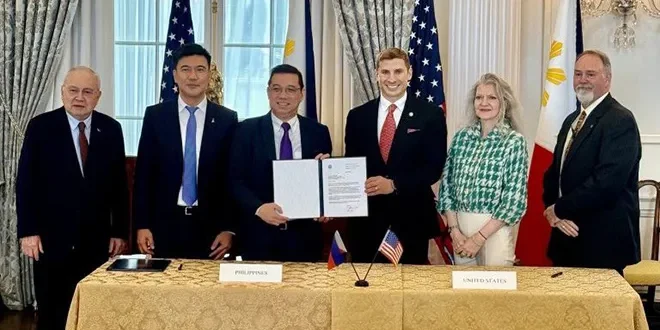
In a report by Reuters quoting the US State Department, it was disclosed that the US and the Philippines will build a 4,000-acre (1,620 hectares) industrial hub after Manila joined a Washington-led initiative to secure AI and semiconductor supply chains.
The Philippines becomes the 13th country to join Pax Silica, a program seeking to safeguard the full technology supply chain, including critical minerals, advanced manufacturing, computing and data infrastructure.
The initiative is a key pillar of the Trump administration’s economic statecraft strategy aimed at reducing its dependence on rival nations and strengthen cooperation among allied partners. Other signatories include Australia, Finland, India, Qatar, South Korea, and Singapore.
The new industrial hub will be built in the Luzon Economic Corridor, a strategic hub for economic activity that includes the capital Manila and neighboring regions with industrial and manufacturing activities.
The State Department said it recognizes that the Philippines holds significant reserves of nickel, copper, chromite, and cobalt which are increasingly vital to global supply chains.
It said the Luzon Economic Corridor (LEC) is a coordinated, high-impact investment in key sectors, including in transportation, energy, digital infrastructure, and advanced manufacturing. The LEC will transform Luzon into a more prosperous and interconnected region while delivering value to American investors.
The Philippines, Japan, and the United States have committed to ramp up infrastructure investments in the corridor under a trilateral framework agreement.
“It is intended to serve as a staging point for a purpose-built platform for allied manufacturing,” the State Department said in a statement.
Opposition in Davao
The plan to construct a major fuel storage facility on the western coast of the Davao Gulf to expand American logistical reach in the Western Pacific was immediately opposed by residents and local officials of Davao City and the provinces in the Davao region, including the Sultanate of Sulu, religious and civic groups in the area.
In a statement, the Davao City LGU said it “does not welcome and will oppose any plan to build foreign military facilities within the jurisdiction of Davao City.”
It is concerning to note that while Rear Admiral Roy Vincent Trinidad, Armed Forces of the Philippines (AFP) spokesman said the oil depot will be owned and operated by the Philippine government, the US War Department posted its real status through a contract opportunity offer in a federal government website on March 31.
The solicitation was described as for a “contractor-owned and contractor-operated fuel storage services in Davao, Philippines” unveiling the lie that Rear Admiral Roy Vincent Trinidad touted.
More and more Filipinos are waking up to the reality that we do not need any more presence of the US military anywhere in the Philippines.