 The Market Monitor Minding the Nation's Business
 Teaser: During the weekend, many of the world’s important central bankers met in Jackson Hole, where the opening speech was awaited with much excitement in the financial markets.
This year’s most important event for central bankers took place from Friday to Sunday this weekend in Jackson Hole, Wyoming, USA. The chairman of the U.S. Federal Reserve Bank (Fed), Jerome Powell, held the opening speech which attracted the attention from the entire financial market. The main theme of the symposium was the macro-economic impact from global super-companies such as Amazon.com and similar corporations. However, the financial market’s short-term focus was on other elements in the opening speech from Powell.
There was a reaction towards President Donald Trump and his attention to the value of the greenback, as coming interest rate hikes could send the dollar higher- leading to more tweets.
Everyone in the financial markets expect another hike on interest rates by 0.25 percentage points in September, and so do I. If one uses the future’s contracts as an indicator, then 62 pct. of the market is positioned for another hike in December. I asses Powell’s comments as he stays on-track with the expected rate hikes. This might trigger some tweets from the White House, but Powell showed enough strength to stay on his chosen path, which is good.
In the past, Fed has allowed international financial turmoil to influence their interest rate decisions, but it is clearly not a heavy argument yet for delaying rate hikes. So far, the crisis includes a smaller number of countries, and if a hard assessment has to be done, these countries have lived high on cheap liquidity without having their own fiscal household cleaned-up. This does not give much respect to the world’s most powerful central bank, which is another reason why it is unlikely that Fed currently gives these circumstances special weight. In addition, the central bank also needs to take USA’s own situation into account.
Firstly, the United States has conducted monetary intervention via the quantitative monetary policy. Almost every time, intervention is an extreme act in a financial market, so it makes sense to just use this solution for a short while. Otherwise, it will influence the pricing of financial assets. We have witnessed this for a number of years now, and just for that reason, Fed is busy pushing up the interest rates again. In addition, the U.S. economy is growing robustly, where a responsible central bank like the Fed, will counterweight increased government spending by simply tightening the monetary policy like hiking interest rates. These two elements, I regard as classic arguments for further interest rate hikes in the United States. Jerome Powell did refer to these circumstances, but on other hand, left the outlook for 2019 open, which is slightly soft.
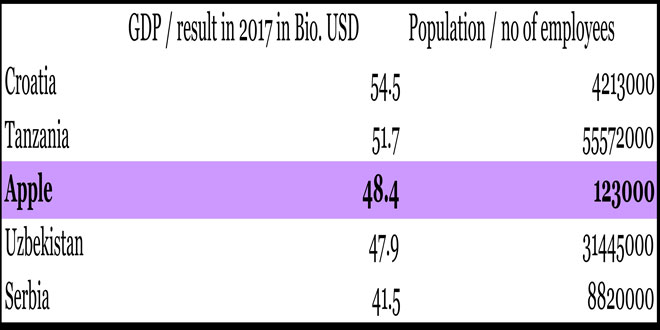
As mentioned initially, the main theme is how big global companies affect the national economies. Investors will not respond to this part of the Jackson Hole in the short term, but nevertheless, the topic is strategically very interesting. Several companies start to grow very big, where table one shows an example of Apple being compared to selected countries.
Both Fed and Powell have previously stated that they are puzzled by the historically strong job market, that so far hasn’t generated any wage inflation. I agree that global super-corporations play a role as they create global production platforms where they can internally allocate the tasks to locations that are currently the cheapest, which in turn contributes to global wage competition.
For consumers, the globalisation also has generated a long-lasting advantage. The internet itself, but also the many e-commerce platforms, mean that it is difficult for retailers to raise prices on many consumer goods. All-in-all, managing national monetary policy in such a globalised world can give a central bank challenges, and it remains exciting how Powell deals with this challenge in the future.