 The Market Monitor Minding the Nation's Business


By Rose Marie de la Cruz
After more than a year, I finally got to visit and interview rice farmers from Nueva Ecija about their experiences using the biofertilizer technology of AgriSpecialist Inc. (ASI), which was granted (after six months of waiting) the certificate of product registration(CPR) for rice and corn only last January. Biofertilizer is among the prescriptions of the shelved Masagana Rice Industry Development Program of former Agriculture Undersecretary for Rice Program Leocadio Sebastian, to improve yields and rejuvenate the country’s acidic soils.
Prior to getting its CPR, ASI deployed farm technicians and sales personnel to all the regions to give away packets of its Bio N (a nitrogen-fixing bacteria) so farmers could try and find out the different benefits in terms of reduced production inputs cost; health of both humans and plants and the root systems and the yield improvement from using the P500 worth of Bio N per hectares (or 5 packets) versus adding more chemicals into the sick soil.
My interviews with three farmers from Talavera-Aliaga, Nueva Ecija last March 7 showed just how happy and optimistic farmers are about being able to improve their productivity, suffer less insect and pest infestation that damage their crops and the cost saving from reducing their use of chemical fertilizer by at least two bags per hectare (now at P1,700 per bag) or a saving of P3,400 per hectare. I interviewed: Arnold Jumaquio, 48 (hybrid rice planter); Juanito Manuel, 69 (inbred rice farmer) and Ferdinand “Amang” de la Cruz, 49 (a tenant farmer who planted both hybrid and inbred in the 8 hectares), who sees rice farming as financially rewarding since it funded the schooling of his three kids (two nursing ladies one of whom will soon be employed and the other on her last year) and the third (a boy who is now senior high school).
One of them received a pack of Bio N from a DA technician, who claimed he needed only one pack per hectare (sus, this speaks of how little they know organic farming since they had been always pushing for chemical fertilizer, the personal choice of their bosses) while two others got their samples of Bio N from the field technicians of ASI.
Seeing their field– very lush, green leaves and sturdy stems, robust root systems with lots of seeds sprouting from between the dense leaves– the farmers were all excited about the potential increases in their yields (compared to purely chemical fertilizer, insecticides and pesticides). They narrated the resilience of their plant against strong rains and winds and intense heat from sunlight. This is because the nitrogen-fixing bacteria (azospirillum) of Bio N embeds itself deeply into the roots and soil.
The farmers who gladly welcomed the ASI technician Roden Quebrantes (for Nueva Ecija and Isabela) read intently (who says they are unschooled?) the simple literature on the packet and followed them to the letter. Even if they double the application of Bio N, there would be no harm to the plant, the farmer and the environment unlike chemicals that have been found harmful to human health and plants.
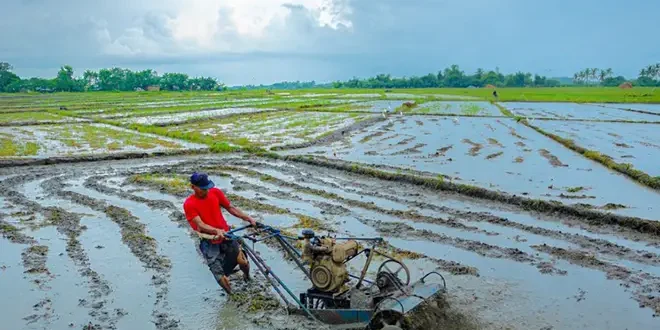
They said they saved from chemical fertilizers (at least two bags of P1,700 per bag), pesticides and insecticides (as there are hardly any pests and diseases near the plants and they saved as well on hiring more farm hands to help them care for the standing crop. One even used machines from land preparation, to broadcasting the Bio N-coated seeds and harvesting.
With the positive outcomes they all experienced, they vowed to propagate the technology to their peers (working in fields nearby or relatives from distant farms) so that they can all experience the bounties of the technology, which was developed by the UP Los Banos Institute of Biotechnology.
The ASI has 120 CNS (crop nutrition specialists) and 20 cluster heads that go around the country promoting and propagating Bio N to rice farmers. Aside from rice, the UPLB-Biotech has also developed Bio N for corn and for other crops, which if strongly pushed by government and the farmers could help us gradually attain food self-sufficiency instead of just importing all our food needs.
The company’s CPR for Bio N rice expires by December 2026 and for corn by December 2028.
ASI has invested over P200 million for its plant in Sta. Rosa, Laguna which is capable of supplying the entire needs of the agriculture sector, given the proper push from the government. Alas though, the lobby from commercial suppliers of chemical fertilizers and pesticides seem to be louder than the benefits the country would achieve from going green through biofertilizer, organic farming and the use of soil ameliorants or enhancers.