 The Market Monitor Minding the Nation's Business
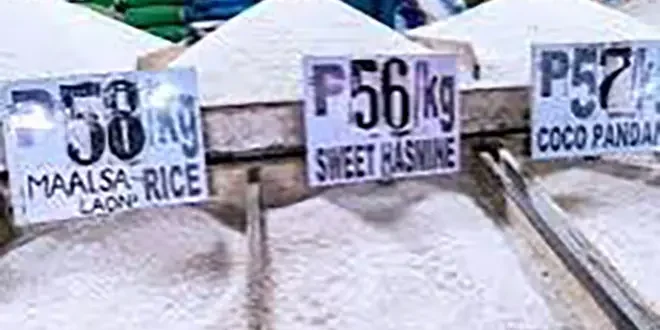

Just glancing at the idea of imposing seasonal tariff for rice, I don’t know just how systematically this can be implemented, without opening the floodgates for corruption and other trade malpractices.
As it is, EO 62, which was revised in June 2024, including changing its nomenclature, failed in its mission to protect local rice farmers from unfair competition posed by cheap imported rice, ensuring food security and stabilizing domestic retail prices despite reducing tariffs from 35 to 15 percent.
The reduced tariff was meant to lower the retail prices and ensure sufficient stocks by allowing cheaper imports when local harvests are not yet coming and even with reducing global rice prices, local retail prices remained high forcing the government to set maximum suggested retail price or MSRP (which also failed) despite government’s efforts to release its stocks to stabilize prices. This is because importers and traders connived to keep their stocks to force the Department of Agriculture to raise domestic retail prices.
The EO was to be enforced from 2024 to 2028 and later carried a provision of periodic review and adjustment of tariffs should the need arise. The EO was a brainchild of the National Economic and Development Authority and concurred by the Department of Agriculture.
And now, NEDA Secretary Arsenio Balisacan is saying the government is open to adopting a seasonal tariff scheme for rice imports to better protect farmers since “there is yet no operational or legal impediments to it.” The DA is agreeable to seasonal tariff adjustments.
“That way, we can stabilize farmers’ incomes and prices that farmers receive,” Balisacan told Business World on the sidelines of the ADB meeting last week.
The Federation of Free Farmers (FFF) proposed implementing levies that are strategically timed to not clash with the height of the harvest season.
Seasonal tariffs would also mean variable rather than fixed duties. Since July last year, the government slashed tariffs on rice imports to 15% from 35% until 2028 to tame spiraling prices.
Balisacan said a study on how to implement the seasonal tariffs, which used to be a primary instrument of the EU and US before the World Trade Organization and with practically a global trade war in the offing, who is following WTO at this time? Everybody’s just changing tariffs everywhere, so we have to find a way to study this,” he emphasized.
“When world prices drop, you raise the tariff so as to keep the price. When the world prices rise sharply, you reduce the tariff. In other words, you’re stabilizing the price faced by farmers. So that’s good,” he explained.
For the past few months, rice inflation has been on a downtrend after the government implemented several measures to tame the retail prices of the staple, which includes the reduced tariff, the declaration of food security on rice in February to release government buffer stocks and the imposition of MSRPs.
NEDA statistics show that in April, rice inflation contracted to 10.9% from the 7.7% decline in March with average price of regular milled falling by 13.3% year on year to P44.45/kg and well milled by 10.4% to P50.54/kg while special rice dropped by 6.2% to P60.69/kg.
But peasant groups still see rice prices staying elevated in most local markets.
The Committee on Tariff and Related Matters (CTRM) is already reviewing the proposal to implement seasonal levies then recommend to the Cabinet before being elevated to the Economy and Development Council, formerly the NEDA Board.”
Groups like the Federation of Free Farmers and SINAG have recommended returning tariffs at 35%.
Meanwhile, the Department of Agriculture (DA) said it is also open to considering seasonal tariffs pending further study.
DA Undersecretary Asis Perez, though conceptually approving the idea of seasonal tariff, said this might cause uncertainty and unpredictability in supply, which have to be removed.
In June 2024, SINAG called EO 62 :a setback for the local agriculture sector and “a complete reversal of our aspiration for food self-sufficiency.
It is a catastrophe for our rice farmers, corn growers, livestock and poultry raisers, will impede local agriculture development, will not guarantee a significant reduction in rice prices, and will only benefit a few privileged importers.”
Starting 1 January 2029, the most favored nation (MFN) tariff schedule rates of duty for in-quota and out-quota subheadings will revert to 40 percent and 50 percent ad valorem, respectively.