 The Market Monitor Minding the Nation's Business
During The 2013 destruction by typhoon Haiyan in the eastern coastal towns, most villages were left with nothing and many islanders perished from the storm surges and tsunamis.
But the residents of Gen. MacArthur in Eastern Samar, a small community in the path of the super typhoon, was spared because it had preserved and treated its mangroves as wildlife treasure. They wouldn’t trade their mangrove for anything.
They were right about thanking their mangroves for saving them.
In the town’s public market, on a small bay that opens up into the Pacific Ocean, there’s no sign of the massive flooding that wreaked havoc elsewhere nearby.
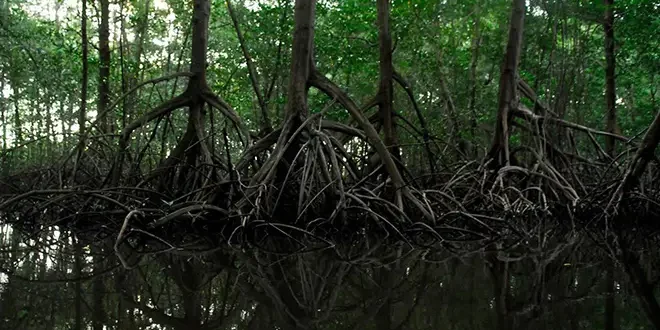
Mangroves form low-lying thickets that hug the shore of coastal areas in tropical regions around the world.
They serve as natural barriers that help dissipate swelling storm surges. The storm killed thousands throughout the country, with Tacloban suffering the most casualties and damage to infrastructure.
Rough estimates show more than 70 percent of the country’s original mangrove forests were destroyed between 1918 and 1994. Many were replaced with fishponds, resorts and other kinds of coastal development.
But some of the mangroves near MacArthur were spared.
UP Professor Rene Rollon, who studied mangroves for over 20 years, says MacArthur residents are right to thank their humble trees. “That’s a huge amount of mangroves. It dissipates a lot of energy. So, actually, it’s protecting the town.”
In fact many experts consider mangroves one of the best defenses against coastal flooding. That’s why MacArthur officials have designated their mangrove areas a local preservation site.
Many other coastal communities in the Philippines and elsewhere are now trying to replant mangroves from scratch, but experts say many rehabilitation projects here have been slow and poorly implemented.
So, for now, MacArthur serves as a rare reminder of the value of natural systems, as the Philippines struggles to regain much of what the country lost to Haiyan.
With its healthy mangrove buffers, that struggle will be far less challenging.
Mangroves are part of coastal forests. Like terrestrial forests in mountainous and inland areas, mangroves forests are highly effective in absorbing and storing carbon dioxide from the atmosphere and from the ocean, earning the tag “blue carbon sinks.”
Thus, mangroves help in mitigating climate change. Carbon dioxide in the atmosphere is one kind of greenhouse gas that damages Earth’s protective ozone layer, leading to a changing global climate.
Dr. Dixon Gevana, director of Forestry Development Center of the UP Los Banos told a recent Policy Forum on Reforestation said that mangrove restoration can contribute as much as four times the value of forest reforestation in sequestering carbon, Business Mirror reported.
Besides climate change mitigation, mangroves also act as natural protective barriers when storm surge occurs.
In the Philippines, mangroves also count among the country’s biodiversity hotspots, where the country reportedly hosts more than half of known mangrove species.
Importantly, for coastal communities, mangroves also play a crucial economic role, acting as nurseries for fish and other aquatic life.
Thus, they are critical in the livelihood of fisherfolks while they also serve as a lifeline for the sustenance of marginalized coastal communities and the population in general.
Yet unexplored, mangroves also have value in eco-tourism as is the case with the Bakawan EcoPark in Aklan, as cited by Dr. Lorena Sabino in the same forum.
However, sadly, Gevana noted that mangroves in the country are in a sorry state of degradation.
Every year, he said, an estimated 330,000 hectares of mangroves are being destroyed. Drivers of this degradation are aquaculture expansion, road construction, infrastructure development and ongoing reclamations.
While many relevant policies are in place, governance is a problem at the local level, Gevana said. There is also a lack of specific guidelines on mangrove planning and restoration. As it is, availability of funding has influenced mangrove restoration efforts, he pointed out.
Questions about where and which species to plant are hardly considered.
More than mere bio-physical aspects, the socio-ecological aspect should be incorporated by factoring in the needs of coastal communities.
Dr. Annadel Cabanban, director of Wetlands International, batted for a whole-society and whole-ecosystem approach for the country’s mangrove restoration program.
Cabanban said this should involve political leaders and multi-stakeholders. She also recommended an integrated approach that encompasses forests in watershed areas down to deltas and mangrove areas.
At the same time, local governments must play an active role in crafting and implementing zoning laws. She called for the designation of a 100-meter belt around coastal areas as well as the reversion of abandoned, under-utilized fishponds for mangrove restoration.