 The Market Monitor Minding the Nation's Business
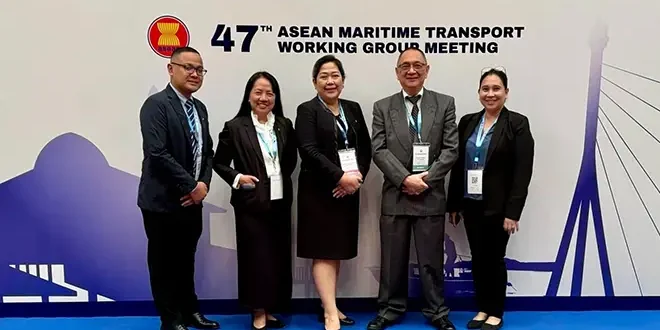
The Regional Strategy on Biofouling Management in the ASEAN Region was adopted by the ASEAN Member States during the 47th ASEAN Maritime Transport Working Group (MTWG), held in Bandar Seri Begawan, Brunei Darussalam, from 17 to 18 September 2024.
The Philippine delegation, led by MARINA Deputy Administrator for Operations, Ms. Nannette V. Dinopol, presented the draft Regional Strategy on Biofouling Management in the ASEAN Region during the ASEAN MTWG meeting. This strategy, a collaborative effort between the Philippines, Indonesia, the International Maritime Organization (IMO), and PEMSEA, aims to develop best practices and standards for improved biofouling management across the ASEAN region. It is a testament to the collective commitment to maintaining healthy marine ecosystems and enhancing the energy-efficient operation of ships.
The adoption of the Regional Strategy paves the way for further capacity-building efforts to support the implementation plan by other ASEAN Member States. With the assistance of the IMO and PEMSEA, the Philippines and Indonesia aim to promote south-to-south cooperation among ASEAN Member States, facilitating capacity building and coordinated action on biofouling management at the regional level.
The Philippines also expressed its deep appreciation to the ASEAN dialogue partners for their unwavering support and the provision of capacity-building opportunities to the member states, as well as to the European Union for its technical assistance, which has been instrumental in helping the Philippines comply with the STCW Convention and the Maritime Labor Convention.
These initiatives align with the recently adopted United Nations Human Rights Council resolution on Promoting and Protecting the Enjoyment of Human Rights by Seafarers. The Philippine-led resolution acknowledges that the challenging conditions seafarers face at sea pose risks to their enjoyment of human rights, safety, and well-being.
The Philippine delegation consisted of representatives from the Department of Transportation (DOTr), MARINA, the Philippine Coast Guard (PCG), and the Philippine Ports Authority (PPA).
Sec. Bautista underscored on Tuesday the role the transport sector plays in increasing the productive capacity of the country’s economy.
“The transportation sector is at the forefront of boosting economic growth by efficiently moving essential services across and between islands and nations,” Sec. Bautista said during the Quezon City Travel Agencies Association’s 25th anniversary.
“The huge investments on transport infrastructure will create jobs, livelihood opportunities and increased economic activities within and around our project sites,” he added.
Groups such as the Quezon City Travel Agencies Association, said Sec. Bautista, are enablers of efficient mobility and connectivity while promoting travel and tourism.
To boost tourism and encourage international tourists to visit the Philippines, Sec. Bautista cited big-ticket projects in the aviation, railway, road and maritime sectors.
He bannered the recently turned over Ninoy Aquino International Airport (NAIA) to New NAIA Infra Corp., modernization of regional airports, as among the big-ticket transport infrastructure projects of the Department of Transportation (DOTr).
Sec. Bautista likewise touted under construction railway projects such as the North-South Commuter Railway (NSCR) Project, Metro Manila Subway, MRT-7, among others.
Other transport projects include the modernization of ports and construction of ports to accommodate cruise tourism, and expansion of bike lanes throughout the country.