 The Market Monitor Minding the Nation's Business
By Rose de la Cruz
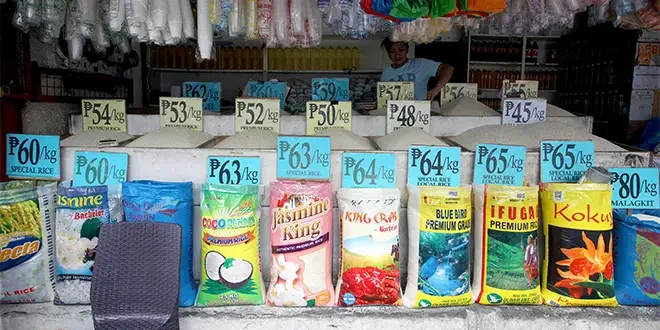
The idea of removing labels like imported rice and premium or special tags in rice sold in all markets is just an affirmation of the lingering colonial mindset of Filipinos when buying products like food, specifically rice as it gives them an image of being well-off than the rest of the hoi polo in their food choices.
However, considering that most of our rice imports are just coming from fellow ASEAN members and even India– not the Western economies– must their grain be more superior than what our local farmers produce. I beg to disagree.
Such branding or labelling is a psychological justification of retailers and those supplying rice to them to jack up their prices because a premium was paid for these stocks– in terms of foreign exchange, shipping costs and other factors, not necessarily quality.
And because they price their imported stocks higher than local produce, the losers end up our local farmers, whom local traders manipulate and underpay to the point that the palay farmers no longer enjoy any income from their produce (after paying for all their production and subsistence loans to these sharks).
Agriculture Secrettary Francisco Tiu Laurel Jr. warned rice importers that their permits will be revoked if they fail to comply with this new policy of removing the words “premium” and “special” from the stocks they pass on to the market. Again, just a warning, sus what good would that do?
Traders, he explained, use these words to justify their inflated prices. The rule would not apply to locally-produced rice.
“Importing rice is a privilege not a right. If traders are unwilling to follow our regulations, we will withhold permits for rice importation,” Laurel said. Again, just a withdrawal of import permits. Why not a more serious penalty and charge them for price manipulation, a market malpractice.
The DA is also exploring the possibility of invoking the food security emergency provision under the Rice Tariffication Law, which would allow the National Food Authority (NFA) to release its buffer stocks in order to stabilize prices.
Also being considered is for the Food Terminal Inc. (FTI) to procure substantial quantities of rice and directly compete with traders and importers in the market. This is a better and logical option, if I may say so.
Despite the reduction of tariffs from 35 to 15 percent under Executive Order No. 62, the DA acknowledged that rice prices have not decreased. Economic managers of Marcos administration had expected a price drop of P6-7 per kilo, which never materialized, even though world market prices have fallen and tariffs were reduced.
According to DA calculations, a P6-8 per kilo markup over the landed cost of rice is sufficient for traders, importers, and retailers to make a profit. For instance, if the landed cost is P40 per kilo, a sale price of P48 per kilo is deemed reasonable.
Laurel has directed the DA’s legal department to examine whether provisions of the Consumer Price Act can be used to charge unscrupulous traders and importers with profiteering.
The DA will also work with the Department of Finance, particularly the Bureau of Internal Revenue, to examine the financial records of rice traders to ensure their pricing practices are fair.
He also proposed enlisting the departments of Finance and Trade in auditing the financial records of rice traders and in assisting in monitoring rice prices, respectively.
Special imported commercial rice sells for between P54 and P64, while imported premium and well-milled rice fetches P52-P60 and P40-P56, respectively, the DA reported on Dec. 20, the mainstream media noted.