 The Market Monitor Minding the Nation's Business

A top official of the European Union (EU) warned the Philippines may lose billions of dollars in trade deals should the government pursue plans to resurrect the death penalty.
EU members do not believe death penalty is a deterrent to fight criminality.
“We are concerned about some of the issues here in the Philippines: the reinstatement of the death penalty, also the extrajudicial killings and the proposal to lower the judicial responsibility age to 9 years – and this is also some of the concerns that we have conveyed to our partners here in the Philippines,” European Trade Commissioner Cecilia Malstrom told reporters on the sidelines of Asean-EU Business Summit in Pasay City last Friday.
Malstrom said reinstituting capital punishment could affect the review of the current trade agreement between EU and Philippines called the Generalized System of Preference Plus (GSP+).
The GSP+ agreement aims to grant the Philippines zero duties on some 6,274 locally-made products.
She explained that the agreement, which is currently under review, required the Philippine ratification of 27 international conventions which cater to human and labor rights, environmental protection, and good governance, among others.
The House of Representatives passed on third and final reading the controversial death penalty bill and has been transmitted to the Senate.
The Senate is currently on a deadlock on the passage of the bill as senators said the support for the bill is split right down the middle.
The Association of Southeast Asian Nations (Asean) and the EU also raised concerns on protectionist and inward-looking policy stances of some world leaders amid the efforts of open and free trade.
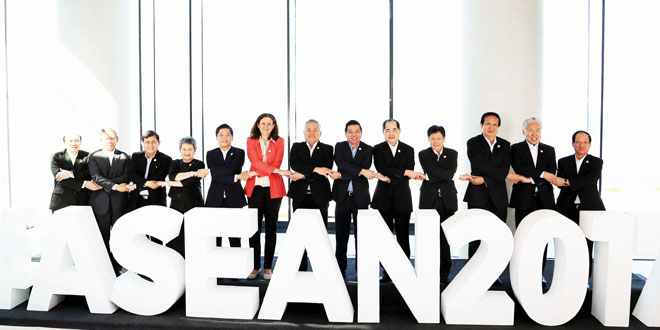
These issues were discussed by Asean Economic Ministers (AEM) and Malmström during the 15th AEM-EU Trade Commissioner Consultations.
In a joint press conference following the consultations, Trade Secretary and AEM Chairman Ramon Lopez said global growth could be sustained through a more integrated economies.
Cooperation to reduce and to further remove barriers to trade would also promote greater flow of goods and services globally in the years to come, said Lopez.
However, protectionist views of some world leaders pose threats to improving trade and global growth, according to the trade official.
“All of us have been hearing some rhetoric, statements from other world leaders. But I guess, the question is whether or not those be translated to actual policies and rules that will really curtail globalization or would be anti-globalization moves,” Lopez noted.
“Certainly, those statements create a certain degree of uncertainty,” he added.
Malmström said benefits of economic integration and globalization should trickle down to micro, small, and medium enterprises (MSMEs) and create more jobs.
“Closing borders, building walls, raising tariff — that’s not a solution; that will reinforce the problem,” Malmström stressed.
During the trade officials’ consultation, Asean and EU reaffirmed commitments to strengthen multilateral trading system and to the World Trade Organization.
Both parties have also expressed interest to resume negotiations for a free trade agreement.
The Asean and the EU also expressed interest to resume rounds of negotiations for a free trade agreement (FTA).
Lopez said the two parties had discussed future steps to re-launch the FTA discussions.
“In order to reinforce the momentum, the AEM and EU Trade Commissioner tasked the Senior Economic Officials to develop a framework encompassing the parameters of a future Asean-EU FTA, and to report back to the next AEM-EU Trade Commissioner Consultations,” Lopez said.
To support the resumption of the FTA talks, the trade chief said Malmström had endorsed during the consultations the Asean-EU Trade and Investment Work Program for 2017-2018.
Lopez said that the Asean-EU Trade and Investment Work Programme for 2017- 2018 aimed to enhance economic cooperation between Asean and the EU by addressing emerging challenges and capitalizing on opportunities for trade and investments.
Moreover, Malmström reaffirmed EU’s commitment to enhance trade and investment cooperation with the Asean.
She noted that the relation between the two regions is “vibrant, good, and developing”.
“From the European Union, we are very committed to strengthening and developing our EU-Asean relations,” the visiting EU trade commissioner said.
“We are committed to open-trade and advancing positive, win-win global trade agenda. So, it is important to find like-minded partners here in Asean to see the value of trade,” she added.
It was in 2007 when Asean and the EU began the FTA negotiations. However, discussions were halted two years later.
But EU has continued talks with Asean countries for bilateral FTAs.
To date, EU has FTA with Singapore and Vietnam, while pursuing rounds of negotiations for trade deals with the Philippines and Indonesia.
“We believe it is important to connect to growing markets and to take away as many obstacles to trade as possible. Having a region-to-region agreement between the EU and the Asean is a long term goal that we’ve been discussing for many years and we are taking steps forward,” Malmström said.