 The Market Monitor Minding the Nation's Business
The past week delivered a barrage of headlines—some expected, some troubling, and one truly astonishing. Businessman Atong Ang has reportedly been charged in connection with the long-running investigation into the disappearance of several sabungeros. Gretchen Barretto, frequently entangled in the public conversation, is notably excluded from the case. Meanwhile, the Commission on Audit flagged a government office for procuring ₱13 million worth of tissue paper, a symbol—almost a caricature—of how casually public funds can be handled.
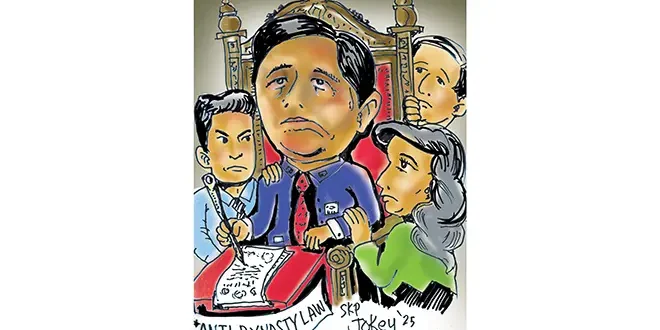
Yet none of these stories match the political shockwave of President Ferdinand Marcos Jr.’s newest declaration: he now favors an anti-dynasty law.
For a presidency that has perfected the art of ambiguity, this sudden clarity is jarring. Political dynasties have long been the cornerstone of the Philippine political structure—nowhere more visibly than in the Marcos family itself. The President’s eldest son is a congressman, widely perceived as undergoing “OJT” for a higher national position. His estranged sister serves in the Senate. His cousin—recently unseated as Speaker—remains a powerful presence in the House.
So, when President Marcos Jr. signals openness to legislation curtailing dynasties, the country must ask: What kind of anti-dynasty law does he really want?
The Constitution is unambiguous: political dynasties are prohibited “as may be defined by law.” Yet, for nearly four decades, Congress has refused to pass that enabling statute. Successive administrations have tiptoed around the issue, and lawmakers—many of them multi-generational officeholders—have ensured that no meaningful bill ever reaches final reading.
Families have turned public office into a vertically integrated career path: the child begins as Sangguniang Kabataan chairperson, moves to municipal councilor, then vice mayor, mayor, representative, governor, senator, and beyond. Imee Marcos was following a similar trajectory before the family’s 1986 exile interrupted the ascent. For countless other political clans, no such interruption occurred.
Some families have even fielded unprepared and unwilling members simply to keep a seat “in the family.” A recent, widely discussed case in Cavite involved a political clan allegedly compelling an inexperienced, neurodivergent son to run for Congress after the patriarch’s sudden death—an indictment of a system where qualifications matter less than surnames.
But perhaps more concerning is what happens after these families gain power. Years of incumbency refine not just governance, but also the art of navigating—and at times bending—the nation’s anti-corruption safeguards. As former officials often admit privately, leaving a paper trail is the mistake of a novice.
Against this backdrop, President Marcos Jr.’s unexpected endorsement of an anti-dynasty bill cannot be taken at face value. His administration is simultaneously cool toward a proposed measure that would replace the Independent Commission on Infrastructure with a stronger, independent commission. Institutional independence, it seems, is treated more skeptically than dynastic limitation.
The President’s true intentions become clearer in the fine print: allies in Congress have floated versions of an anti-dynasty bill riddled with exemptions—the very loopholes that would allow dynasties to persist under the guise of reform. Some proposals would allow family members to run simultaneously so long as they represent different cities, provinces, or regions. Others would restrict only immediate relations, leaving extended clans free to dominate entire districts.
If that is the model the President is signaling Congress to pursue, then his newfound enthusiasm risks becoming another political sleight of hand: an anti-dynasty law that enshrines, rather than dismantles, dynastic power.
Will the President press Congress to pass the bill? Almost certainly. But unless the nation remains vigilant, the law we get may simply legitimize the very system it purports to end.
The Philippines deserves a genuine anti-dynasty law—one that restores competition, empowers citizens, and returns public service to merit rather than inheritance. The President has opened the conversation. It is now up to the public to demand that the final legislation matches the promise, not the pretense.