 The Market Monitor Minding the Nation's Business

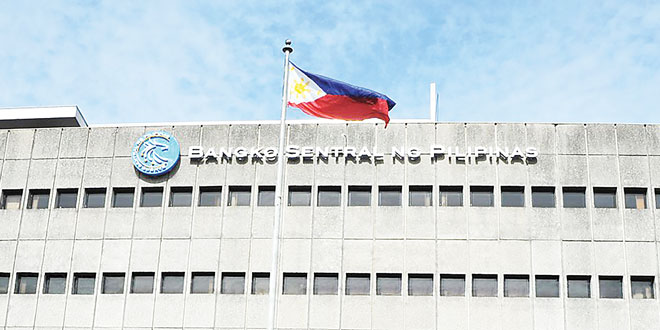
By Riza Lozada
A stronger US currency and national government (NG) repayments of its foreign liabilities resulted in a $2.7 billion drop in the country’s foreign debts to $74.8 billion last year from $77.5 billion a year ago, Bangko Sentral ng Pilipinas (BSP) data showed.
Foreign debts by the end of last year also fell 2.4 percent from the previous quarter’s $76.6 billion, the data showed.
The BSP said the reduction in foreign debts from last year was attributed to net principal repayments by both the public and private sectors which reduced total debts by $3.4 billion; previous periods’ audit adjustments that lessened debts by $168 million due to late reporting; and a downward foreign exchange revaluation adjustments $36 million.
These factors that lowered the debt stock was partly offset by an increase in non-residents’ investments in Philippine debt papers issued offshore by $846 million, the BSP data showed.
From the previous quarter, foreign exchange (FX) revaluation adjustments resulted in a $1.8 billion cut in the value of obligations as the US dollar strengthened against third currencies, particularly the Japanese yen; net principal repayments of $611 million, mainly by the NG and the state holding firm Power Sector Assets and Liabilities Management Corp. (PSALM); and prior periods’ audit adjustments that removed $73 million from total debts.
The downward impact of these developments on the debt stock was partially offset by the $591 million transfer of Philippine debt papers from residents to non-residents that had the effect of increasing outstanding external debt, the BSP said.
External debt refers to all types of borrowings by Philippine residents from non-residents, following the residency criterion for international statistics.
The BSP added key external debt indicators remained at comfortable levels at the close of 2016. Gross international reserves stood at $80.7 billion as of end-2016 and represents 5.6 times cover for short-term (ST) debt under the original maturity concept.
The debt service ratio, which relates principal and interest payments (debt service burden or DSB) to exports of goods and receipts from services and primary income, is a measure of adequacy of the country’s FX earnings to meet maturing obligations.
As of end-December 2016, the ratio increased to 6.9 percent due largely to the increase in payments from $5.6 billion in 2015 to $7.1 billion last year.
Large principal payments in 2016 included the full redemption of bonds at maturity by the PSALM, worth $638 million; national government (500 million euros or about $557 million); and two universal banks (aggregating $425 million). Nevertheless, the DSR has consistently remained well below the international benchmark range of 20.0 to 25.0 percent.
The external debt ratio (a solvency indicator), or total outstanding debt (EDT) expressed as a percentage of annual aggregate output (GNI), continued to improve by year-end to 20.4 percent from 21.1 percent in the third quarter of 2016, and 21.9 percent as of end-2015.
The same trend was observed using GDP as denominator, with the Philippine economy growing by 6.6 percent in the last quarter of 2016 and by 6.8 percent for the entire year, the BSP said. The country’s external debt remained heavily biased towards medium- to long-term (MLT) accounts which represented 80.6 percent of total.
This means that FX requirements for debt payments are well spread out and, thus, more manageable, the BSP said.
The weighted average maturity of MLT accounts stood at 16.9 years, with public sector borrowings having a longer average term of 22.9 years compared to 7.9 years for the private sector.
Short-term (ST) liabilities comprised the 19.4 percent balance of debt stock and consisted of bank liabilities, trade credits and other non-bank liabilities.
Public sector borrowings were down to $37.5 billion or by $1.8 billion from $39.3 billion in September 2016, with share to total correspondingly declining from 51.3 percent to 50.1 percent largely due to negative FX revaluation adjustments of $1.7 billion and net principal repayments of $896 million, which were partly offset by the increase in non-residents’ investments in public sector debt papers of $749 million.
About $30.5 billion (81.5 percent of public sector obligations) were NG borrowings, it said.
Private sector debt likewise declined, albeit by a smaller amount, from $37.33 billion in September 2016 to $37.29 billion, although share to total increased to 49.9 percent from 48.7 percent due to the substantial drop in public sector accounts. Obligations to foreign banks and other financial institutions worth $25.8 billion comprised the largest share of outstanding debt at 34.5 percent, followed by official sources such as multilateral and bilateral creditors totaling $22.9 billion or 30.6 percent.
Borrowings in the form of bonds/notes held by non-residents worth $22.4 billion accounted for 29.3 percent, while the rest at $4.2 billion or 5.6 percent were owed to foreign suppliers and exporters.
The country’s external debt stock remained largely denominated in US dollar (65.1 percent) and Japanese yen (12 percent).
US dollar-denominated multi-currency loans from the World Bank and Asian Development Bank had a 12.8 percent share to total, while the remaining 10.1 percent balance consisted of 17 other currencies, including the Philippine Peso (6.3 percent), SDR (2.1 percent), and the Euro (1.1 percent).