 The Market Monitor Minding the Nation's Business
By Riza Lozada
The previous administration failed to invest in infrastructure, resulting in a gap in development and in monumental economic and social costs to the economy, among which is vehicular traffic that costs P2.4 billion daily, Budget Secretary Benjamin Diokno said.
According to him, the terrible traffic congestion hampers the well-being of Filipino commuters, who have to spend a quarter of their day on the road, and takes away time from more productive activities.
A study by the Japanese International Cooperation Agency (Jica) study projects that if the traffic situation is not improved, the cost will climb up from P2.4 billion daily to as much as P6 billion daily by 2030.
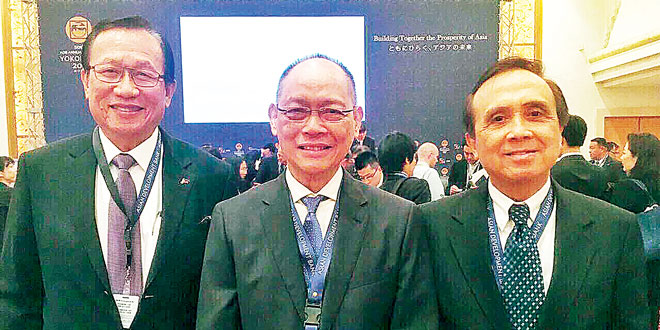
Diokno, who spoke before the 2017 Global Think Tank Summit in Yokohama, Japan, said the Philippines’ standing in the Global Competitiveness Rankings of the World Economic Forum (WEF) gives another reason to upgrade the infrastructure of the country.
Data from 2009 to 2017 show that the country steadily rose in global competitiveness from 87th place to 47th in 2016, or by 40 notches in seven years.
“This is one reason the Philippines is called the ‘next Asian tiger.’ But, definitely, if we want to sustain this rapid development and modernization, our infrastructure has to keep up,” Diokno said.
With the theme “Achieving Balanced Growth in Asia and the World for Sustainable Development”, the summit was organized by the Asian Development Bank Institute (ADBI) and the Think Tanks and Civil Societies Program (TTCSP). Leading public policy experts, academicians, business leaders, and private sector representatives from across the globe participated in the summit.
The Global Think Tank Summit discussed prevailing issues confronting Asia and the world, including widening inequality, social instability, protectionist sentiments, decelerating economic growth, environmental degradation, among others, in hopes of formulating inclusive and sustainable solutions.
In particular, Diokno attended the breakout session on high quality infrastructure and sustainable growth.
In line with the breakout session, the Budget secretary shared the trend of public infrastructure provision in the Philippines from 1986 to the present.
He mentioned that economic conditions prevented the Philippines from investing heavily in public infrastructure for the past three decades.
“[T]he Philippines has not spent more than 3 percent of its gross domestic product (GDP) for public infrastructure, and it’s not surprising why: the level of public debt was huge; the costs of servicing it was high; and its revenue-to GDP ratio was low. Of course, it did not help that it had a string of fiscal conservatives running its fiscal policy,” said Diokno.
The many years of underinvestment for public infrastructure has led to an infrastructure gap. Despite the bullish prospects on the Philippine economy, which registered a 6.9-percent GDP growth rate in 2016, its poor and collapsing infrastructure remains to be a growth constraint.
“The Philippines’ infrastructure indicators consistently result to dismal scores that pull down its overall competitiveness. For overall infrastructure, we lag behind our Asean (Association of Southeast Asian Nations)-5 neighbors, especially Thailand, Malaysia, and Singapore. What is worrisome is that its overall infrastructure rank has steeply declined from 94th in 2009 to 112th in 2017,” said Diokno.
In response, the Duterte administration is embarking on an ambitious infrastructure program unmatched in the country’s history, and expected to usher in a “Golden Age of Infrastructure”.
“And for this year, the first bold step we took was to appropriate an amount of P847.2 billion, or $17 billion, for infrastructure in the 2017 national budget. This level is equivalent to 5.3 percent of GDP…” the Budget chief said.
“We will sustain this level of investment, such that P8 to P9 trillion, or $160 to $180 billion, will be spent on public infrastructure for the next six years. Likewise, as a share of GDP, infrastructure spending will rise from 5.3 percent in 2017 to as high as 7.4 percent come 2022,” he added.
Diokno also briefly discussed tax reform and budget utilization reforms to ensure that the ambitious infrastructure program of the Duterte administration is appropriately implemented and financed.
In conclusion, Diokno emphasized that the Philippines has the right ingredients and the right leaders to transform the Philippines into the “Asian Tiger” it is capable of becoming. Hence, it is only a matter of time before the Philippines becomes a better, safer, fairer, and more prosperous country.