 The Market Monitor Minding the Nation's Business
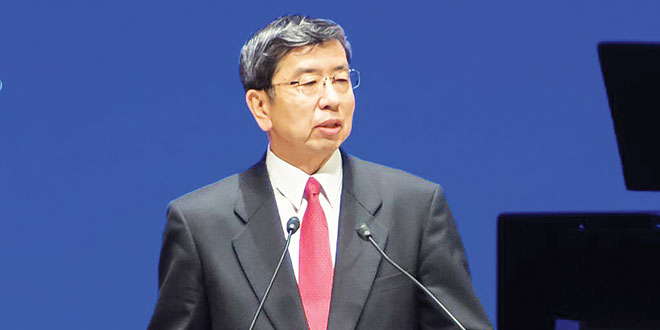
Investment in infrastructure will remain a priority of the Asian Development Bank (ADB) as the bank prepares a new long-term strategy to respond to rapid regional changes, said ADB president Takehiko Nakao at the 50th Annual Meeting of ADB’s Board of Governors held recently in Yokohama, Japan.
ADB’s Annual Meeting hosts about 6,000 government officials, academics, business officers, civil society representatives, and members of the media. Under the theme “Building Together the Prosperity of Asia,” the Annual Meeting is also a celebration of ADB’s 50 years of development work in Asia and the Pacific.
Nakao said ADB’s achievements over the past half century can be summarized as combining knowledge and finance, promoting good policies, and fostering regional cooperation and friendship.
Nakao said that ADB’s future direction will be led by Strategy 2030, ADB’s new long-term strategy that will map the best ways ADB can support Asia’s growth and address development challenges including poverty, climate change, urbanization, aging, and widening inequalities. ADB continues to hold consultations on the strategy with a wide range of stakeholders from around the region and in donor countries.
Investment in infrastructure will be an ADB priority under Strategy 2030, including enhanced support for infrastructure projects that incorporate advanced technologies.
Nakao remarked that “Asia will need $1.7 trillion per year in investments in power, transport, telecommunications, and water through 2030.”
Support for social sectors, especially health and education, is a second ADB priority area under Strategy 2030. For this,
Nakao stated that ADB “will support universal healthcare systems and cross-border initiatives to combat communicable diseases such as malaria, tuberculosis, and HIV.”
Strategy 2030 will also prioritize support for gender equality. Gender is a cross-cutting issue that influences all aspects of society and economic development. According to Nakao, ADB will “design projects that help women and girls secure higher skills, better health, more jobs, and a larger voice in decision-making.”
ADB will upgrade efforts to mobilize private resources for development, including through public–private partnerships under the emerging new long-term strategy. “ADB is supporting an increasing number of private sector projects in education, health, and agriculture,” said Nakao. “Funding micro-, small-, and medium-sized enterprises through local banks will remain a priority.”
Nakao also stressed the need to continue to reform ADB as part of Strategy 2030. Among the reforms, he said ADB will “strengthen its sector and thematic expertise, enhance staff capacity, and streamline procedures.” He added that the institution will deepen its collaboration with civil society, academia, the private sector, and local governments.
Nakao highlighted ADB’s progress in 2016. He noted that total ADB operations last year, including cofinancing and technical assistance, reached $31.7 billion. ADB’s loan and grant approvals reached a record high of $17.5 billion, a 9% increase from the previous year. Climate finance reached $3.7 billion, up from $2.6 billion in 2015. Cofinancing with public and private partners increased to $13.9 billion. This includes ADB’s first two cofinanced projects with the Asian Infrastructure Investment Bank for roads in Pakistan and a natural gas project in Bangladesh.