 The Market Monitor Minding the Nation's Business

Digital kidnappers are after enterprises in Southeast Asia (SEA). Global cybersecurity company Kaspersky predicts the trend will continue this year and beyond, albeit in more sophisticated and targeted ways.
Ransomware is a type of malware that locks one’s computer and mobile devices or encrypts one’s electronic files. To get the “decryption” key or to get your data back, a ransom is required by the cybercriminals behind the attack.
As a threat, ransomware has come a long way since the first ransomware attack was carried out all the way back in 1989. Since 2016, the malicious actors behind this threat have shifted from targeting users to bigger enterprises. Known high-impact incidents include the Wannacry Ransomware, with an estimated $4 billion-worth of aftermath.
Because of its high return-of-investment nature, ransomware groups continue to attack enterprises globally, including businesses in SEA.
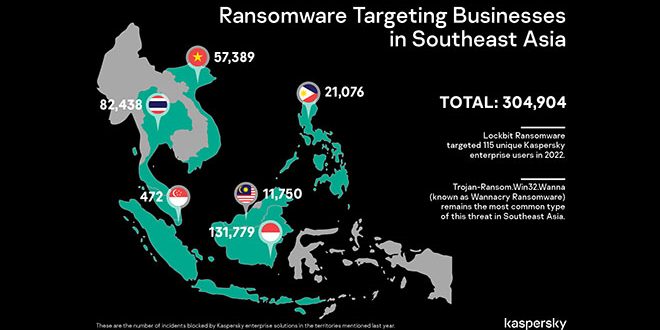
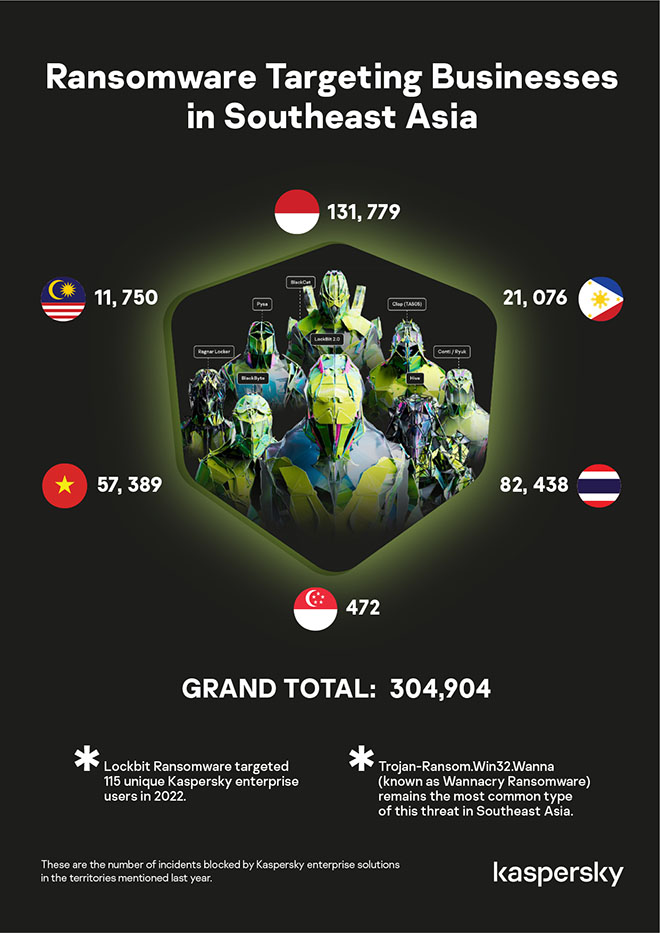
Fresh statistics from Kaspersky revealed that a total of 304,904 ransomware attacks eyeing businesses here have been blocked by Kaspersky’s business solutions last year.
Indonesia recorded the highest number of incidents foiled by Kaspersky B2B solutions (131,779), followed by Thailand (82,438), and Vietnam (57,389). The Philippines logged a total of 21,076 ransomware attacks; Malaysia had 11,750, and Singapore had 472.
Kaspersky’s telemetry also revealed that the most common types of ransomware targeting businesses in the Philippines are:
• Trojan-Ransom.Win32.Crypren
• Trojan-Ransom.Win32.Wanna
• Trojan-Ransom.Win32.Stop
• Trojan-Ransom.Win32.Gen
• Trojan-Ransom.Win32.Agent
“One of our fresh studies has already confirmed that three-in-five of businesses here have been victims of a ransomware attack. Some once, but half have fallen prey multiple times. Our 2022 data reveals this threat will continue to be a menace for enterprises in SEA because it makes good money for cybercriminals because some business executives think ransomware is just overhyped by the media, and because enterprise security teams are actually overwhelmed and undermanned to detect and respond against it,” comments Yeo Siang Tiong, General Manager for Southeast Asia.
The cybersecurity talent gap continues to haunt enterprises here. A study even logged a 2.1M gap in available local security staff urgently needed in the greater Asia Pacific region.
In addition, only 5% of enterprise leaders here confirmed that they have internal incident response capabilities, or they have a regular IT team or service provider to figure out a ransomware attack.
This explains why a majority (94%) of them would need external help in the case of an incident.
“We sound the alarm against ransomware targeting enterprises in SEA but at the same time, we hear that IT security teams and business executives need help to build their cybersecurity capabilities. With the emerging trend of Ransomware 3.0—a more dangerous version of this threat -– expert cybersecurity that goes beyond your usual endpoint solution is necessary. At the center of this is equipping your security teams with expert detection and incident response tools like Kaspersky XDR (Extended Detection and Response),” adds Yeo.