 The Market Monitor Minding the Nation's Business
By Tracy Cabrera
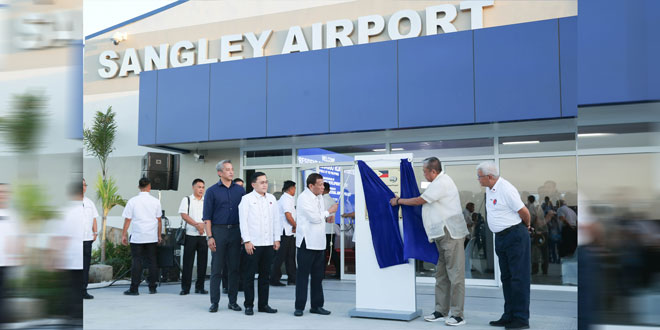
Targeted to be a copy of Munich Airport in Germany–Europe’s best airport and one of the very few with five-star status in the world—Sangley Point International Airport (SPIA) in Cavite is envisioned to replace the Ninoy Aquino International Airport (NAIA) in its operations as the premier entry point and gateway to the Philippines.
Speaking before the Kapihan sa Manila Bay media forum held at the historic Café Adriatico in Malate, Manila, Cavite governor Juanito Victor ‘Jonvic’ Remulla proudly presented the blueprint for the implementation of the development of the former United States naval base in Sangley Point into a critical aviation infrastructure that would help decongest NAIA and serve as a long-term international gateway for Metro Manila and the Cavite-Laguna-Batangas-Rizal-Quezon (Calabarzon) area.
In discussing Sangley’s development, the 52-year-old provincial chief executive described the project will be a catalyst for economic development for his province that would not only bring in business and investment opportunities but would also directly create some 50,000 jobs for Caviteños and likewise professionals who would be needed for employment.
“The SPIA will become a world-class and first-class international airport with an annual design capacity that would reach up to 130 million passengers,” Remulla boasted, adding that the planned airport is conceptualized and designed by a group of leading international consultants, including those from Arup Group Ltd and the United Kingdom’s National Air Traffic Service (NATS).
“Munich Airport will serve as SPIA’s operational technical partner. We have competitively selected the consortium of Lucio Tan-owned MacroAsia Corporation (MAC) and China Communications Construction Company Ltd (CCCC) as joint venture partner for the first phase and without any cost and sovereign debt or guarantee to our national government,” the governor pointed out.
Based on the project’s implementation, the first phase of SPIA will include the new Sangley Connector Road and bridge, which is a six-lane highway complete with urban mass transportation connectivity that will directly link the Kawit interchange of Cavitex to the airport.
“SPIA’s construction will involve the development of an interim first runway designed to operate alongside NAIA as a supplemental runway that has a capacity for 25 million passengers. It will also be ecologically sustainable since it will be built based on green structural design standards with a comprehensive rehabilitation plan for surrounding areas,” Remulla disclosed.
“After Phase I, the second phase will expand the development for a second runway for an annual design capacity of 75 million passengers that is further expandable to up to four runways for an ultimate annual capacity of 130 million potential passengers,” the governor further disclosed.