 The Market Monitor Minding the Nation's Business
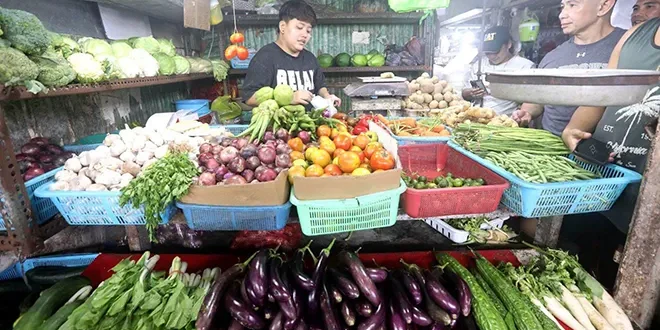
Government spending on food security must go beyond agricultural production and place greater emphasis on food affordability, nutrition, and effective delivery of social protection programs, according to a new study by the Philippine Institute for Development Studies (PIDS).
The research, presented during a PIDS webinar, found that while public investments in agricultural development have increased substantially over the past decade, funding remains unevenly distributed across the various components of food security.
The study, titled “Food Security Sectoral Analysis: Strengthening Access to Safe and Nutritious Food for Every Filipino,” examined government expenditures from 2015 to 2025 and assessed the 2026 national budget against selected food security indicators.
PIDS Senior Research Fellow Roehlano Briones and Supervising Research Specialist Agnes Kristine Quilinguing reported that agricultural development appropriations climbed from ₱89 billion in 2015 to ₱278 billion in 2026, representing an average annual increase of about 11 percent.
Under the 2026 budget, agricultural interventions received approximately ₱231.5 billion, equivalent to 3.4 percent of the national budget. Meanwhile, food-related social protection programs were allocated ₱68.9 billion, or 1.01 percent.
These programs cover agricultural development, school feeding, supplementary nutrition, and other initiatives intended to address hunger and improve access to nutritious food.
One of the fastest-growing allocations was the school-based feeding program, whose funding more than doubled to ₱25.7 billion in 2026, accounting for over half of the social protection allocation.
Briones cautioned, however, that higher appropriations do not automatically translate into better food security outcomes. He emphasized the need for policies that improve agricultural productivity, protect farmers’ incomes, and ensure affordable food supplies.
He also called for a balanced approach to domestic production and imports, allowing the country to meet consumer demand while strengthening agricultural commodities where Filipino farmers have a competitive advantage.
The researchers likewise identified fragmented responsibilities among national government agencies and local government units as a major obstacle to effective implementation and monitoring.
Quilinguing recommended identifying all agencies involved in food security, introducing a dedicated food security budget tag and establishing a unified results framework for the 2028 National Expenditure Program.
Budget execution figures for 2024 further revealed disparities among agencies. The Department of Social Welfare and Development disbursed 88.1 percent of its covered appropriations, followed by the Department of Education at 86.2 percent. The Department of Agriculture recorded 62.5 percent, the Department of Agrarian Reform 64.1 percent, and the National Nutrition Council 61 percent.
Department of Agriculture executive assistant Enrique Dela Cruz stressed that budget utilization figures alone cannot determine whether government interventions are delivering meaningful results.
He called for closer monitoring of actual expenditures and their impact on agricultural yields, food prices and dietary quality, particularly in commodities such as vegetables, fruits, legumes and fish.
Novel Bangsal, executive director of the Budget and Tax Research Bureau of the House of Representatives’ Congressional Policy and Budget Research Department, also emphasized the importance of aligning government expenditures with national development targets.
The study ultimately called for a comprehensive monitoring and evaluation system that tracks not only funding and program implementation but also measurable improvements in food availability, affordability, nutrition, and long-term stability.