 The Market Monitor Minding the Nation's Business
 Teaser: One Emerging Market country that causes general headwind is Turkey, and this will not stop in the near future.
Almost every day, bad economic stories are churned-out from Turkey. It seems like an economic implosion is happening all of a sudden. The truth is that the country is at minimum, exploring a really serious currency crisis with deeply negative consequences for the economy – the Turkish lira has lost 50 pct. in value within the past year, though the largest part of the move happened during the past 3 months, though it’s not sudden at all….
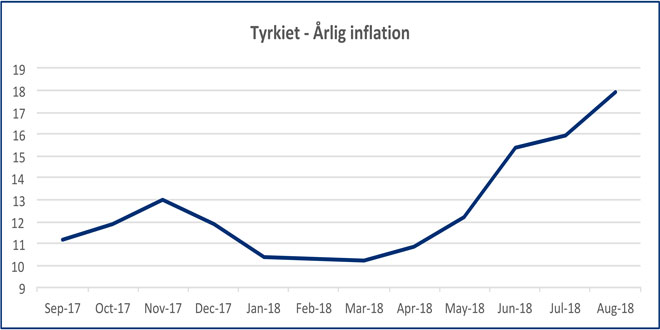
Last Monday, the 3rd of September, Turkey published more data showing that the economic situation is out of control, which is much more serious than just “a cause for concern”. As the graphic shows, the inflation has now reached 18 pct. in Turkey.
One should remember that the country has not been hit by an unfortunate external event, but the problems are self-inflicted by the government. From an investors perspective, it has long been obvious to leave the country. The increased political control of the country’s central bank at the beginning of the year was definitely the last reason needed to justify an exit.
Since the problems are of domestic origin, the end of history is a real economic collapse- or at best, a hard economic downturn followed by economic reforms to restore the faith in the economy. Foreign investors and companies have already lost money on the Turkish lira’s steep drop, though the coming economic spiral also will be felt by foreign investors. I also pay attention to the European banks that have increased their credit risk on Turkey during the recent years. But how bad is it in Turkey?
To express it diplomatically, it is not good at all, and it will be worse. At the moment, the negative consequences of the currency crisis are spreading within the domestic economy. Several companies have gone bankrupt and even a utility company has closed-down its power plant in the city Bursa.
For households, electricity tariffs have been recently been raised by nine pct., and people are cancelling their travels abroad as they could not afford them any longer. These are just examples, but the government argues that the economy is fundamentally healthy and thereby tries to avoid economic reforms. The last resort of action is if the central bank shows enough courage by hiking the interest rates significantly. It will be far to serve as any sort of cure, though it might help to stabilise the Turkish lira slightly as the first step
My greatest attention is focused however, is on how much the economic turmoil in Turkey affects other Emerging Markets countries. So far, I do not see any risk spreading yet. It remains my view that the problems are isolated to individually affected countries such as Turkey, Argentina, and partly Indonesia and South Africa. However, the development in Turkey contributes to continued increased nervousness across all emerging market countries, with a majority of investors still pulling out of Emerging Countries.
But there is a lesson that Turkey is learning right now, which at minimum, I expect will spread to some corporations in Emerging Markets. The cheap and abundant U.S. dollar liquidity did not only find its way to finance government deficits, but also to the corporate balance sheets.
I expect that the dollar liquidity in the financial system will be reduced during the coming 24 months, where some corporations might need to fight more for refinancing, though I regard it as the minor risk. Worse is that many Emerging Market currencies are currently losing in value to the USD, which makes it more expensive to repay the loan if the currency risk was left open. This in particular has my attention concerning Asian corporations.
This is another reason why I keep my view that the coming six months will prove more headwind in many Emerging Countries. Some nervousness are justified and some are not, which after all means that investors will return to Emerging Markets countries that have worked hard over time to keep the fundamental economic conditions in good shape.