 The Market Monitor Minding the Nation's Business
By DIEGO C. CAGAHASTIAN
The local semiconductor industry stands to realize unprecedented growth when plans for the Luzon Economic Corridor under the Pax Silica initiative of the United States materializes, although many sectors have expressed concern if these developments will indeed result in blessings for Filipinos.
The Marcos administration has reserved 1,619 hectares of land in Tarlac for the establishment of a Pax Silica facility, for use by the United States for 100 years, free of charge, and where US federal law is supreme.
On the surface, this is expected to boost further the local semiconductor industry, whose current member-firms are situated in economic zones in Calabarzon, Cebu, and Central Luzon.
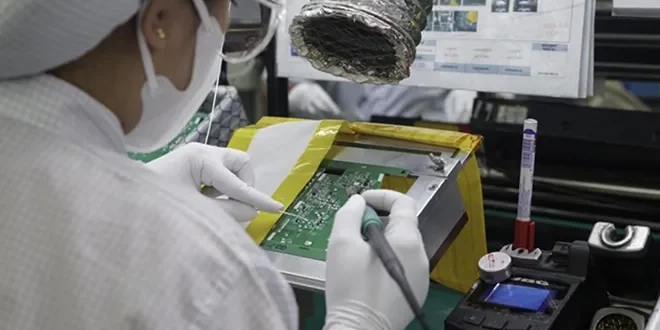
They are busy on assembly, testing and packaging (ATP) of semiconductors, rather than the front-end wafer fabrication, but this can experience scaling up with expertise provided by other Pax Silica members like Japan, South Korea and Germany.
As this developed, the Philippines is seeking a $280-million loan from Manila-based Asian Development Bank (ADB) to finance research into the domestic production of semiconductors, the Department of Trade and Industry (DTI) said.
“We are working closely with ADB on the ASCEND (Advancing Skills, Competitiveness and Enterprise-Driven Innovation) program, which is vital to our ASEAN Semiconductor roadmap,” Trade Secretary Ma. Cristina A. Roque said.
She said the program aims to position the Association of Southeast Asian Nations (ASEAN) as a global hub for high-tech manufacturing.
ASCEND is still subject to review and approval by the National Economic and Development Authority Board’s Investment Coordination Committee.
The ADB has yet to disclose the timeline for implementing ASCEND. The loan amount could also be subject to change, it said.
In a statement, the ADB said the program aims to boost R&D in selected state universities and translate them into commercially viable products.
“It will improve collaboration mechanisms between education institutions and industry enterprises through grants for applied research, startup incubation, and enterprise development,” ADB said.
The project will also support facility upgrades and training programs to match industry needs, it said.
“This investment initiative builds on previous ADB support that promoted Industry 4.0 development and opportunities identified for technology-driven startups,” the lender said.
The Philippine semiconductor industry is the country’s largest export sector, accounting for 60 percent of merchandise exports and generating over $49 billion annually.
Loan from the ADB is expected to accelerate the allied manufacturing and advanced packaging of the semiconductor products.
The United States considers its keen competition with China in the areas of semiconductors, artificial intelligence and critical minerals, both extraction and refining of rare earth minerals, as a national survival issue.
This situation has become an American priority, especially when the Trump administration found itself unable to control Israel’s resolve to start a war of choice in West Asia, particularly against Iran.
But even before this shooting war, the contest between China and America had been pronounced, with each flexing their economic and military muscles. The US realized that if it is to continue engaging China in the race for technological innovation, it has to secure its supply chains of the needed minerals and other resources.
For all intents and purposes, the Luzon Economic Corridor will be a humongous US territory carved out of Central Luzon, and will definitely impact on the environment, energy and water resources of the region without regard for the sentiments of CL residents.
Pax Silica in the Philippines is another burden for the Filipino people to benefit America and its oligarchy in Wall Street and the industrial-military complex. And the end goal is to put a hurdle on the rise of China as a global superpower.