 The Market Monitor Minding the Nation's Business
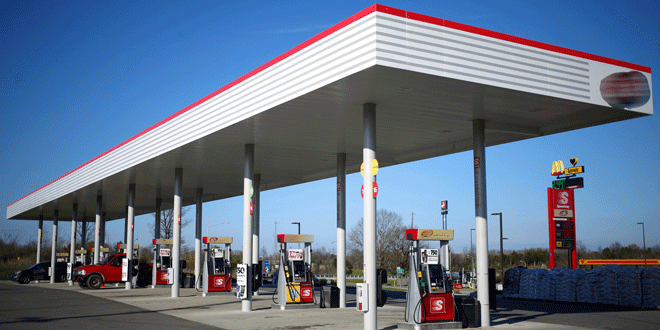
Global demand for fuel is expected to remain weak for the first half of 2020 and may recover in the second half as economies start to open up after COVID-19 pandemic, according to Moody’s Investors Service.
In its report “Recession and uncertain demand recovery weigh on oil prices in 2020-2021,” Moody’s said the global refining and marketing sector is experiencing the negative effects from lower demand for refined products as the COVID-19 pandemic that had suspended much economic activity.
The huge drop in demand for oil products globally—as economies shut down in March and April—has knocked oil markets severely off-balance, sending oil prices into a dramatic plunge.
Moody’s said oil refiners and marketers low profits and high working capital, leading to severely reduced cash flow especially in the first half.
“Demand for gasoline and jet fuel has plummeted, while diesel use has held up better. Refinery utilization rates have declined and some facilities have been idled, but refined-product inventories continue to increase,” it said.
“Unit profit margins have deteriorated at the lower utilization rates, and refiners’ total cash flow has suffered. Refiners’ crack spreads have been weak, and lower oil and natural gas prices have not offset weak product prices or lower sales volumes,” Moody’s said.
In the Philippines, Petron Corp. and Pilipinas Shell Petroleum Corp. have not been spared as they manage losses from keeping idle oil stocks in storage facilities.
Oil companies have an inventory of 30 days for crude oil and finished products, and household LPGs have a supply for at least seven days.
According to the Department of Energy, LPG stocks are currently good for 16.4 days, while the combined finished products are enough for 29.17 days and crude oil for 22.2 days for a total of 51.37 days.
Use of refined products such as diesel, bunker fuel and jet fuel is expected to remain weak until mid-year, Moody’s expects a slow recovery in demand as countries start easing restrictions and reopening their economies.
“Refiners are focused on liquidity, having used cash to fund very large working capital outflows during the price downturn and building up high-cost inventories. Some reductions in borrowing-base facilities have left speculative-grade refiners with less available unused borrowing. We expect that working capital will be a source of cash in the second half (of) 2020 as the economy and demand recover,” it said.