 The Market Monitor Minding the Nation's Business
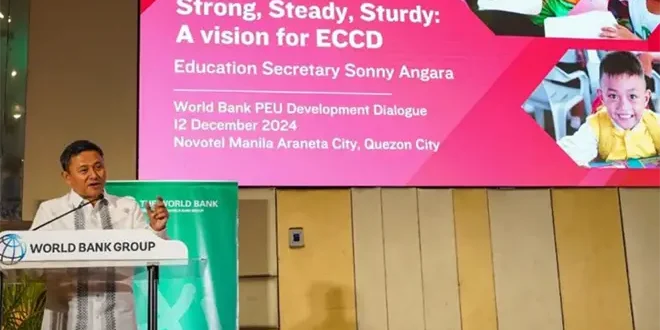
Education Secretary Sonny Angara on Friday called for greater investments in the education sector, emphasizing its critical role in shaping the nation’s future.
Speaking at the World Bank Philippines Economic Update Development Dialogue, Angara highlighted the urgent need to prioritize Early Childhood Care and Development (ECCD) to give Filipino children the foundation they need to thrive.
“We need to invest more in the early years of our people to ensure every Filipino child born today has the chance to dream, learn, grow, and contribute to our nation’s progress,” he said.
Angara underscored that robust early investments in human capital are vital for fostering a forward-looking society. He also noted the importance of local government units (LGUs) in implementing effective ECCD programs.
Citing a January 2024 UNICEF report, Angara revealed that 78% of Filipino toddlers are not enrolled in early learning programs, with 90% of children in the Bangsamoro Autonomous Region in Muslim Mindanao lacking access to early education.
To address these challenges, President Ferdinand R. Marcos Jr. has directed key government agencies—including the Department of Education (DepEd), Department of Health (DOH), and Department of Social Welfare and Development (DSWD)—to collaborate in providing comprehensive care for children.
For 2025, the ECCD Council received a 12% budget increase, with P277 million allocated for constructing National Child Development Centers. The ECCD curriculum is also being revamped to ease the transition to formal schooling.
Senators Alan Peter Cayetano and Pia Cayetano echoed Angara’s call, urging greater funding for education to secure the country’s long-term development.
Alan Peter warned that inadequate education funding risks the Philippines falling further behind regional peers. “Tingnan mo ang kalidad ng education ngayon, and ‘yan ang kalidad ng bansa (Look at the quality of education now, and that will be the quality of the country) 10, 15, 20 years from now,” he said, citing Vietnam’s educational and economic strides as an example.
While Filipino students and teachers have excelled in international competitions, he lamented the lack of financial support for the sector. He called for partnerships between the government, private sector, and LGUs to address funding gaps and support local universities and colleges.
Alan Peter also urged young people to demand greater prioritization of education. “Kung [ang] young people, they start demanding talaga (If young people really start demanding) – you give us less talk and put more money in education – it will happen,” he said.
Pia Cayetano, meanwhile, criticized significant budget cuts to education in the 2025 General Appropriations Bill, including PHP11.57 billion from DepEd, PHP26.91 billion from the Commission on Higher Education (CHED), and PHP641.38 million from the University of the Philippines.
She argued that these reductions, alongside the PHP25.80 billion cut to the DOH, are detrimental to millions of Filipinos struggling to access quality education and healthcare.
“Health and education must always be our top priority if we are to build a stronger, more sustainable future for all. We must never compromise on our commitment to always put quality healthcare and education first for every Filipino,” she said.
“These reductions are a terrible step backward,” she added, vowing to advocate for increased resources in these critical sectors, which she described as the foundation of a sustainable and equitable society.