 The Market Monitor Minding the Nation's Business
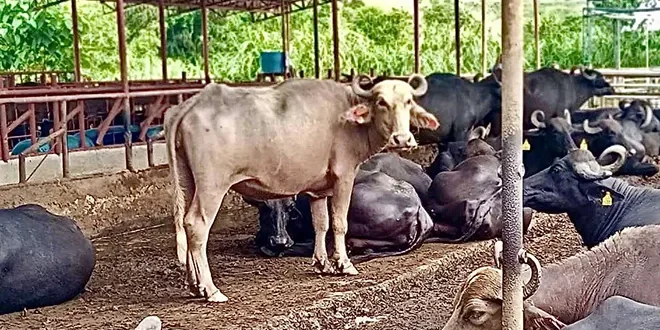
THE NATIONAL Dairy Authority is eyeing more cattle imports and stronger funding streams to whip the industry into higher productivity.
The country’s dairy industry remains import-dependent for decades, as local production can only meet a miniscule amount due to the lack of sufficient government funding, private sector investments and proper infrastructure.
The country is now gearing to meet a milk self-sufficiency of five percent by 2028, through the importation of cattle herds, the construction of key infrastructure and targeted interventions.
NDA administrator Marcus Antonius Andaya said dairy production is expected to reach 53 million liters by the end of 2026, as the agency seeks to fulfill its self-sufficiency target of 3.3 percent.
He said dairy output would be buoyed by the expected arrival of imported cattle to expand the national herd, about 1,600 heads of Holstein Jersey cattle are expected to be imported from Australia, meant to improve the country’s dairy herd.
The agency projects a 22.4-percent increase from the 43.2 million liters in milk production last year.
The imported cattle will be placed within NDA stock to acclimate to the country’s tropical climate or be bred with local stock before they are distributed to dairy farmers.
Andaya said the agency tapped its 2025 budget to purchase an initial batch of 800 cattle in August, with another 800 to be procured under its 2026 allocation in October.
He added that both batches are undergoing the procurement process, noting that delays in shipment may push back its production targets until early 2027.
“We can still do it even without infusion, with the aggressive institutional support that we are giving now as well as feeds, we can still reach it. We’re on track,” Andaya said.
He also noted that the conflict in the Middle East has caused shipping costs for cattle imports to increase to P220,000 per head.
Andaya said the NDA is targeting a milk sufficiency of 3.3 percent this year, bringing it closer to the government’s five percent target by 2028. The country’s self-sufficiency was at 2.2 percent in 2025.
“That is our objective, and we are confident that we will get it. Even if it’s short and reaches about three percent, that’s good enough,” he said.
Andaya added that the agency would propose a P1.5-billion budget under the 2027 national spending plan to expand its support towards the country’s dairy industry.
The agency will use P500 million for regular administrative and programmed expenses, while around P1 billion will finance the expansion of stock farms.
“We’ll be creating three more stock farms, we’ll be creating feed centers,” he said.
The agency has been constructing several stock farms nationwide to expand the country’s dairy herd and increase dairy self-sufficiency. imported dairy cattle are kept within stock farms to acclimate to the country’s tropical climate before they are distributed to farmers.
The NDA was allocated about P2.38 billion under the 2026 General Appropriations Act, a significant increase from its P531 million proposal.
He added that the NDA’s budget would also be supported by P1.5 billion under the Animal Competitiveness Enhancement Fund.
The NDA will allocate around P700 million in herd build-up, P500 million for food safety, animal extension support and training services, while the remaining P333 million will be for the development of animal feeds and forage.
Andaya said the NDA is targeting to construct more three stock farms and feed centers under its Tier 2 budget proposal. Targeted locations include Sorsogon, Baguio and Negros Island.
He said the NDA currently has four operating stock farms – Bohol, Agusan del Sur, Cotabato and Nueva Ecija – with its fifth stock farm in Bukidnon to be operational within the year.
Andaya said that stock farms typically have a capacity to hold 150 heads of cattle and cover about 50 hectares.
To further support the country’s milk self-sufficiency and production target, the NDA plans to secure a P2 billion loan from the French government to develop an expansive dairy facility under the Philippine Dairy Project.
The project seeks to create a state-of-the-art dairy farm in Bohol using French technologies and materials. It has a capacity of more than 300 heads of cattle, producing more than 10 metric tons of raw milk a day.
The Philippine and French governments are conducting a feasibility study, expected to be released in the coming months.
“Before we avail of the loan, we want to see first what the result of their feasibility study will be, it is about to come out,” Andaya said.
Last year, a memorandum of understanding was signed between the NDA and France-based Phylum SARL for the conduct of a feasibility study.
Andaya added that the P2 billion loan would be used to purchase French technologies, infrastructure and animals, as materials for the planned dairy facility.
He said the NDA is awaiting the approval of the feasibility study to move forward with the construction of the farm and the importation of animals.
He said the facility would be an extension of the NDA’s existing stock farm in Ubay, Bohol.
“In addition to that, they will establish a farm there using their facilities, their technology, their know-how and their animals,” he added.
The NDA is also in exploratory talks with the Czech Republic for training and capacity building for farmers.
Andaya said that an official communication of its offer was sent by the Czech government last April.
“We got a message from the Embassy of the Czech Republic offering capacity training and benchmarking,” he added.