 The Market Monitor Minding the Nation's Business
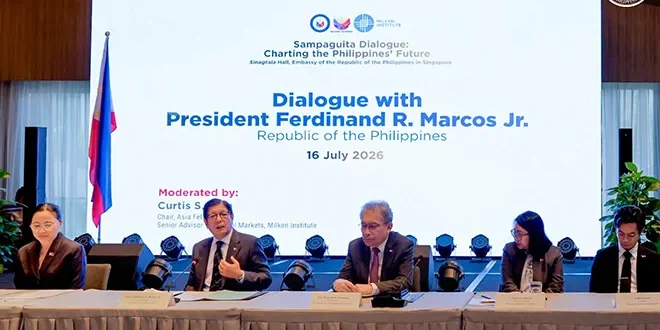
President Ferdinand Marcos Jr. invited global business leaders to invest in the Philippines last week, citing sweeping economic reforms, major infrastructure projects and a business-friendly environment that continue to strengthen the country’s resilience amid global uncertainties.
Speaking at a business roundtable co-hosted by the Milken Institute and the Philippine Embassy in Singapore, Marcos said the Philippines remains one of Southeast Asia’s most promising investment destinations. He pointed to the country’s upper-middle income status, sound macroeconomic fundamentals and a workforce of about 52 million.
“The Philippines remains committed to creating a stable, competitive and investment-friendly environment,” the President said. He added that the government is pursuing policies that encourage long-term investments and improve the country’s overall business climate.
Marcos highlighted several reforms that have expanded investment opportunities. These include relaxed foreign ownership rules in public services and retail trade, the extension of land lease agreements for foreign investors to up to 99 years, and the opening of renewable energy projects to full foreign ownership.
He also underscored the government’s enhanced investment incentives program. Qualified projects may now enjoy up to 40 years of combined tax and non-tax incentives, making the Philippines more competitive in attracting capital.
Infrastructure development remains a key priority under the administration’s Build Better More program. Marcos said the initiative covers more than 200 flagship projects with an estimated value of USD170 billion.
Among the priority projects is the Luzon Economic Corridor. The President said it is expected to position the Philippines as a regional hub for advanced manufacturing, electronics and critical mineral processing.
Marcos also reaffirmed the government’s commitment to renewable energy. He said the country aims to raise renewable energy’s share in the power generation mix to 35 percent by 2030 and 50 percent by 2040.
The President likewise emphasized the importance of expanding trade partnerships. He said the government is working to conclude at least five more free trade agreements to improve market access for Philippine products and attract more foreign investments.
The Philippines is already a member of the Regional Comprehensive Economic Partnership and has existing free trade agreements with Japan, South Korea and the European Free Trade Association. Separate negotiations with the European Union and Canada are also ongoing.
The business roundtable was organized by the Department of Foreign Affairs through the Philippine Embassy in Singapore, with support from the Department of Trade and Industry. The event formed part of the President’s working visit to Singapore.
Marcos thanked the Milken Institute and the participating business leaders for their continued confidence in the Philippines. He said the government’s reforms would create more opportunities for global partnerships and sustain the country’s economic growth.